

Introduction
Milestone 1: Value Discovery marks the start of opportunity specific work in the GTM Execution Phase of the Value Accelerator GTM Blueprint.
It is the first opportunity specific Milestone, where sales shifts from demand creation (Milestone 0) to structured qualification and joint problem exploration.
The Value Discovery Milestone begins once a specific lead has been identified and there is mutual agreement to have an exploratory meeting.
This typically aligns with the creation of a new sales opportunity in the customer relationship management system.
Value Discovery is a mandatory Milestone for every vendor adopting the Value Accelerator GTM Blueprint.
Purpose
Most B2B vendors struggle with low win rates because they pursue the wrong sales opportunities.
The root cause is often weak discovery, where sales reps qualify interest instead of qualifying value, urgency, and readiness.
Milestone 1: Value Discovery exists to prevent this.
It enables sales reps to qualify sales opportunities early, based on evidence that a real business problem exists and that the customer organization is able and willing to act.
This Milestone is not about pitching a solution.
It is about understanding the current situation, validating whether a valuable partnership is possible, and gathering the inputs required for the next Milestones.
A successful Value Discovery covers four domains:
- Problem identification and quantification: Confirm the problem is real, relevant, and costly. Clarify impact, visibility, and what improves if the problem is solved. This enables early go or no go decisions.
- Commercial insight activation: Discovery is an opportunity to shape thinking, not only to collect facts. Introduce a commercial insight that challenges assumptions and reframes what is really driving the problem.
- Early argumentation testing: Test hypotheses about priorities, decision drivers, and likely objections. Use customer responses to refine the narrative before building the value presentation in Milestone 2: Value Presentation.
- Buying group and decision process clarity: Identify key stakeholders, mobilizers, and the buying process. Capture success criteria, internal constraints, competing initiatives, and decision timelines to reduce late stage surprises and improve forecasting.
Value discovery creates mutual clarity and momentum.
Avoid slides. Use strategic questions, relevant insights, and collaborative dialogue to decide whether and how to move forward.
Methodology
Value Discovery Criteria
Value discovery must be criteria based, not intuition based.
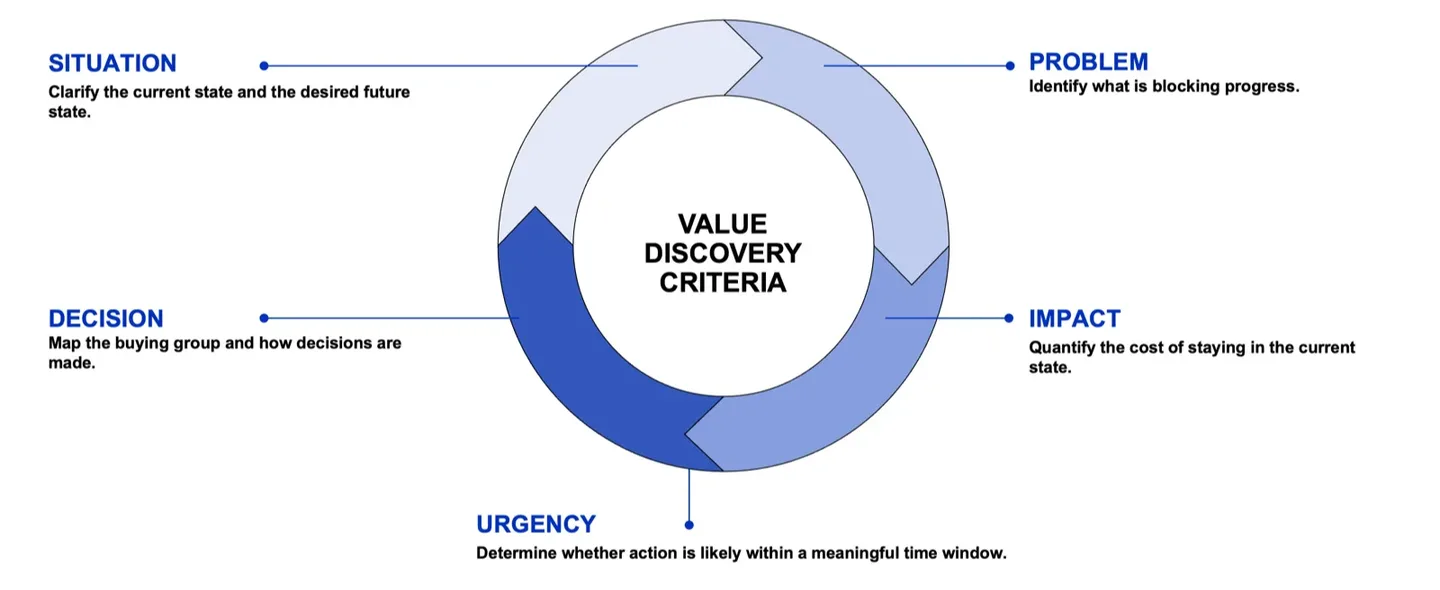
While many discovery frameworks exist, the Value Accelerator uses five criteria that define whether a sales opportunity is real and worth pursuing:
- Situation
- Problem
- Impact
- Urgency
- Decision
These criteria structure the discovery conversation and create comparable qualification across sales reps and opportunities.
Situation
Clarify the current state and the desired future state.
- What outcomes define success
- Which initiatives and KPIs matter most
- Where execution stands today against those priorities
Problem
Identify what is blocking progress.
- What is not working today
- What root causes sit behind the symptoms
- What has already been tried, and why it did not resolve the issue
Impact
Quantify the cost of staying in the current state.
- What financial, operational, or strategic impact is created by the problem
- What improves if the problem is solved
- Whether the impact is visible enough to drive internal alignment
Urgency
Determine whether action is likely within a meaningful time window.
- What events, deadlines, or triggers create pressure to act
- What other initiatives could delay progress
- Whether the topic has leadership attention
Lack of urgency is a signal to nurture, not to forecast.
Decision
Map the buying group and how decisions are made.
- Who validates technically, financially, and operationally
- Who owns budget and approval
- Which criteria will be used to choose an approach
- What steps the customer typically follows to engage a vendor
Capture formal approvers and informal influencers, and note whether a mobilizer is present to drive internal change.
Customer Mobilizer
The Value Accelerator uses the concept of Customer Mobilizer as defined in The Challenger Customer.
A mobilizer is rarely the most senior stakeholder, but is often the person who can move the organization forward.
A mobilizer typically can:
- build internal consensus
- challenge the status quo
- push the buying group toward action
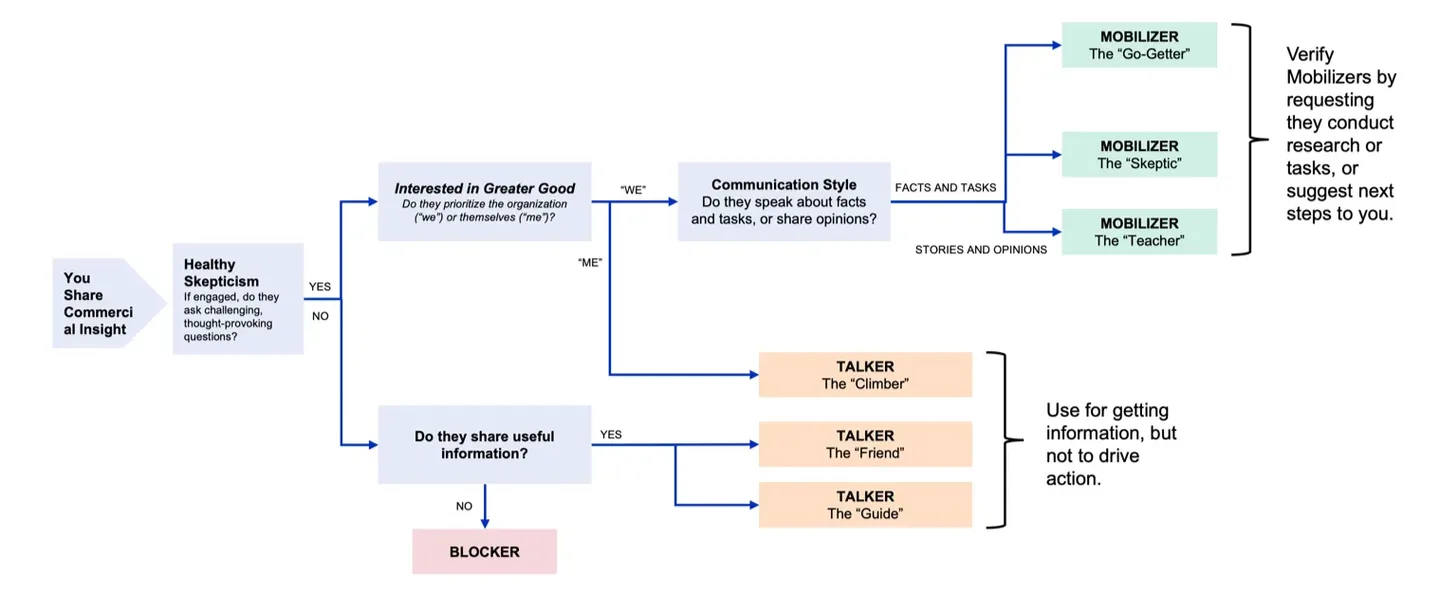
Mobilizers generally show up in three profile categories:
- Go-getters: convert intent into action
- Teachers: influence peers by sharing insight and building understanding
- Skeptics: pressure test assumptions and improve decision quality
How to qualify a mobilizer
Look for observable signals:
-
Healthy skepticism: They challenge ideas, ask sharp questions, and test the commercial insight. Curiosity plus pushback is a stronger signal than polite agreement.
-
Buying group perspective: They speak in terms of “we” and “our.” They care about outcomes for the wider organization, not only their own function.
-
Communication preference: They tend to lean one way:
- Quantitative: responds to metrics, benchmarks, and clear logic
- Qualitative: responds to stories, examples, and change narratives Match the style, without changing the core message.
-
Ability to mobilize: Give a small next step between meetings, for example bringing a peer, validating priorities, or confirming decision criteria. Follow through is the proof point.
Recognizing a mobilizer early reduces deal risk and increases the chance of building consensus before formal evaluation starts.
The diagram below outlines a simple mobilizer qualification flow that sales reps can use during discovery.
Measuring Value Discovery Quality: The CRM Challenge
After every discovery interaction, document the five criteria clearly in the CRM: situation, problem, impact, urgency, and decision.
To test quality, use the CRM challenge from Gap Selling by Keenan:
- A sales rep peer selects a random opportunity in the CRM and reads the discovery notes without sharing the customer name.
- If the opportunity owner can recognise the account and the deal context from the notes alone, discovery quality is strong.
- If not, discovery was shallow. Reopen the topics, ask sharper questions, and improve the notes until the opportunity is clear without relying on memory.
Refer to Sales Enablement Artifacts for supporting materials.
Execution
The Value Discovery Milestone is an ongoing qualification and learning effort.
It starts with the first exploratory conversation and continues as new stakeholders join the buying group.
Each interaction sharpens understanding of the customer situation, the problem economics, and the decision dynamics.
The first discovery call is the key filter. It determines whether the opportunity is worth pursuing and whether a credible path to value exists.
To execute this Milestone, complete these activities:
- Company and persona research
- Prepare the value discovery question map
- Organize and Execute the Discovery Meeting
- Follow up
This Milestone is owned by the sales rep.
Detailed instructions for each activity are provided in the sections below.
1. Company and Persona Research
High quality discovery starts with preparation.
Research provides the context needed to ask relevant questions, introduce credible insight, and avoid spending meeting time on basic facts.
Focus on two areas:
- Company research: Understand the customer context and direction. Capture strategic priorities, public initiatives, investments, constraints, and external forces shaping decisions. Use sources such as press releases, investor updates, annual reports, sustainability reporting, and public strategy statements.
- Persona research: Understand the stakeholder behind the title. Capture responsibilities, likely success measures, current priorities, and language used to describe problems. Review public signals such as role descriptions, conference talks, interviews, and professional posts.
This preparation enables the sales rep to:
- Open the conversation with relevant context
- Use peer examples that match the customer reality
- Ask questions that fit the persona’s goals and constraints
- Spot early mobilizer signals through how the stakeholder reacts and responds
Good research keeps discovery focused on impact, urgency, and decision dynamics instead of background gathering.
2. Prepare Value Discovery Questions
Effective discovery feels natural to the customer, but it is planned and intentional from the vendor side.
Prepare a question set that covers the five Value Discovery Criteria:
- Situation
- Problem
- Impact
- Urgency
- Decision
Build the questions using the six building blocks defined in Milestone -2: GTM Foundation:
- Ideal customer profile
- Target personas and business objectives
- Value proposition
- Customer mental model
- USPs
- Commercial insight
Each question must do two jobs:
- uncover real customer context and facts
- test a hypothesis from the value selling system
Example angles:
- From the commercial insight: Many teams underestimate the cost of [issue]. How is [KPI or cost driver] measured today, and where does it show up in reporting.
- From the ideal customer profile: What foundation is already in place in [relevant area], and where is it still manual or fragmented.
- From target personas and business outcomes: What outcomes are most critical this quarter, and what would be considered a measurable improvement.
Guidelines:
- Prioritize questions that expose root causes, not symptoms.
- Use quantified follow ups to move from narrative to impact.
- Use decision questions early enough to avoid late surprises.
- Use questions and small follow ups to identify mobilizers and decision makers and bring them into the next conversations.
3. Organize and Execute the Discovery Meeting
A strong Value Discovery meeting starts with disciplined setup.
- Keep the customer group small, ideally one or two participants, to encourage openness and reduce internal posturing.
- Send a clear invite focused on the customer, stating the purpose, for example: explore challenges around [topic] and confirm whether there is a mutual fit to proceed.
- Add a simple agenda:
- short introductions and context
- 2 to 3 discovery questions based on current hypotheses
- next steps if fit and urgency are confirmed
Book 30 to 60 minutes. This is enough to cover the key discovery criteria while keeping pace and respecting time.
4. Follow up
A discovery call only creates momentum if the output is captured and reused.
- Write a short summary: Document Situation, Problem, Impact, Urgency, and Decision, plus the commercial insight reactions and the agreed next steps. Share it with the customer.
- Update the CRM: Log the same criteria in a structured way so the full vendor team can understand the opportunity fast.
- Align the internal team: If the opportunity proceeds, loop in the right colleagues early, for example presales and bid management, and clarify ownership for the next step.
This follow up turns one conversation into a shared direction and prepares a clean transition into Milestone 2: Value Presentation.
Quality Gates
- Situation, Problem, Impact, Urgency, and Decision are documented in a way the opportunity is clear without naming the customer.
- The customer confirms a problem worth solving, with meaningful impact and a clear trigger or timeline.
- Fit is validated against the value proposition and the commercial insight.
- At least one stakeholder is identified who either shows mobilizer behavior or holds formal decision authority.
- The next meeting is agreed, including purpose, attendees, and timing.
Sales Enablement Artifacts
Register for free on the Value Accelerator website to download templates and tools that support execution of this Milestone.
Sales enablement artifacts. The templates, canvases and calculators for this milestone are free to download.
Get the Value Discovery toolkit