
Introduction
GTM Foundation (Milestone -2) is part of the GTM Setup Phase.
This milestone is mandatory. It defines the strategic foundation required to run a scalable, insight led, value based Go-to-Market (GTM) System.
This milestone is not executed per customer. It is executed at product or industry level, typically once per year, or when:
- Launching a new offering
- Repositioning the value proposition
- Entering a new market, addressing new customer segments
Moreover, this Milestone sets the foundations of a value-based Go-to-Market System needed to:
- Engage prospects with relevance
- Communicate differentiated value
- Run outcome driven customer conversations
Therefore, this Milestone must be completed before engaging individual customer opportunities and it requires collaboration across sales, marketing, and product teams to align on one shared direction.
Once completed, this Milestone reduces reliance on top sales reps and turns GTM execution into a structured, repeatable system that supports consistent revenue growth.
Purpose
The purpose of the GTM Foundation Milestone is to define the foundations of a value-based GTM system, that enables consistent messaging, customer relevance, and scalable GTM execution across sales, marketing, and product.
Without proper GTM foundations:
- Sales conversations depend on individual talent
- Marketing messages are inconsistent
- Product, sales, and marketing move in different directions
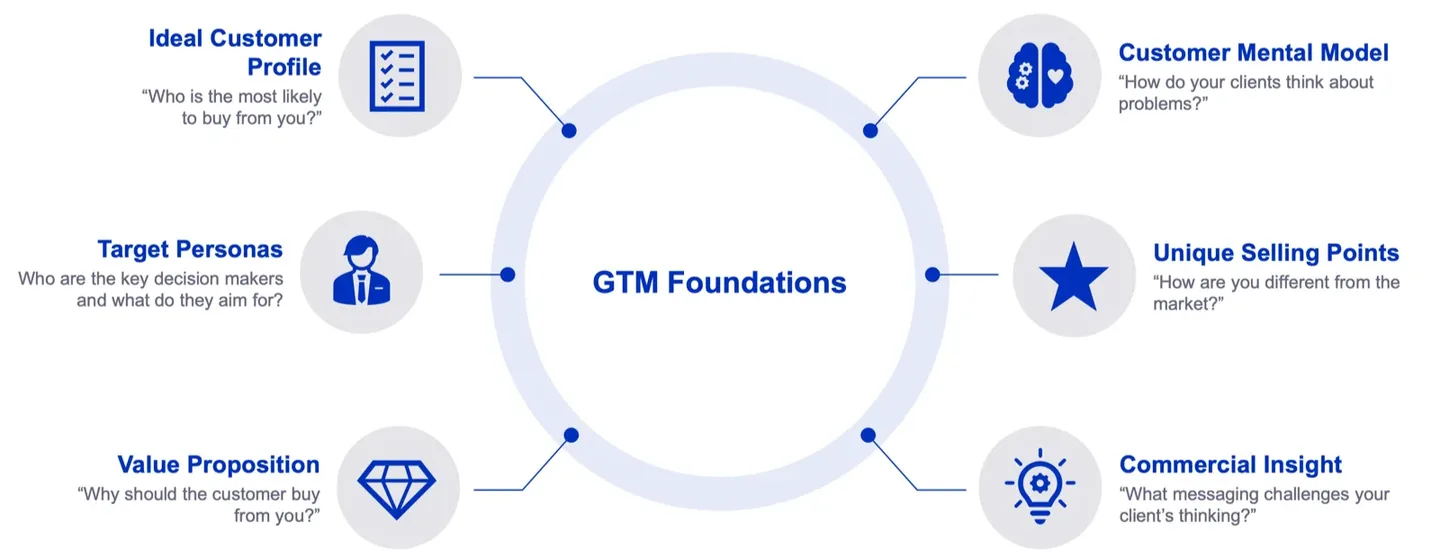
This Milestone defines, as the name suggests, the foundations of a value-based GTM system, which are:
- Ideal Customer Profile: What companies are most likely to buy from us
- Target Persona: Who decides, and what they aim for
- Value Proposition: Why customers buy offerings like ours, the outcomes they want and the problems they want to solve
- Customer Mental Model: How customers think about their own business objectives
- Unique Selling Points (USPs): Why the customer should buy from us, and not from a competitor
- Commercial Insight: What message challenges customers’ thinking, and creates urgency
When these foundations are clear, GTM execution becomes structured, scalable, and insight led.
Methodology
Ideal Customer Profile
The ideal customer profile defines which companies are most likely to buy our offerings, and benefit from it.
A strong ICP includes:
- Company size, revenue, budget fit
- Industry focus
- Company goals and priorities
- Geography coverage
- Current tech stack and processes
- Legal and compliance constraints
- Service and delivery limits
A clear ICP helps teams:
- Focus on high fit accounts
- Improve lead qualification and pipeline quality
- Increase win rate by targeting the right customers
Target Personas
Target personas define who is involved in the buying decision, and what each stakeholder aims to achieve.
For each persona, capture:
- Role in the buying group
- Target objectives and success metrics
- Pressures and constraints
- Decision drivers and objections
Clear personas enable:
- Messaging that resonates across the buying group
- Sales conversations tied to real priorities
- Faster alignment, better deal velocity
Value Proposition
The value proposition explains why customers buy this type of offering.
It is category level and customer led. It captures the outcomes customers want and the problems they are trying to solve when they invest in solutions like ours.
A strong value proposition is:
- Outcome focused, not feature focused
- Written in customer language, not internal terminology
- Broad enough to apply across the ICP
- Specific enough to be credible and useful in conversations
Typical value outcomes include:
- Cost reduction
- Efficiency improvement
- Revenue growth
- Risk reduction
The value proposition becomes a unique value proposition only when combined with the vendor’s USPs, which explain why the vendor is the best option to achieve those outcomes.
Customer Mental Model
The customer mental model is a causal map that explains how the buying group believes business success is created.
It connects strategic goals to execution reality, and shows the cause and effect logic customers use to justify priorities and decisions.
In the GTM Foundation Milestone, the customer mental model is captured as a structured chain:
C level objectives → driving factors → target persona objectives → driving factors → pain points → use cases
This map makes explicit:
- What outcomes leadership and target personas aim to achieve
- Which drivers and root causes customers believe influence those outcomes
- Which pain points block progress
- Which use cases customers see as the most direct path to improvement
The purpose is not to document opinions in isolation. It is to visualize the customer’s internal logic, so sales, marketing, and product can design messaging and commercial insight that starts from the customer’s reality, then challenges what is missing, outdated, or underweighted.
Unique Selling Points (USPs)
USPs are the capabilities that set the vendor apart in a way that matters to the customer.
A USP is:
- Unique, only the vendor can claim it
- Valuable, it creates business value for the customer
- Defensible, competitors cannot easily copy it
- Sustainable, it remains true over time
A USP is not:
- Standard market features
- Generic benefits or outcomes
- Buzzwords such as innovative, green, user friendly, solution
Commercial Insight
A commercial insight is a short statement that shifts how the customer thinks about business success.
It starts from the customer mental model and connects the vendor’s USPs with either:
- Customer outcomes and objectives
- Driving factors and root causes behind those outcomes
- Pain Points
- Target Use Cases
A strong commercial insight:
- Shows understanding of the customer’s current logic
- Highlights a critical connection the customer is missing or underestimating
- Makes the consequence of inaction clear, in business terms
- Leads the customer to consider the vendor’s USPs as key for success
A commercial insight does not describe products or services.
It is used to create relevance and urgency across multiple personas and to open the door for value based engagement in campaigns, discovery conversations, and proposals.
Creating commercial insight requires collaboration across sales, marketing, and product.
Refer to Sales Enablement Artifacts for supporting materials.
Execution
To execute GTM Foundation (Milestone -2), complete these activities:
- Define ideal customer profile
- Define target personas
- Define value proposition
- Define Customer Mental Model
- Identify Unique Selling Points
- Define commercial insight
- Commercial Insight Continuous Validation and Adaptation
Execution requires a cross functional team, typically including:
- sales and pre-sales
- marketing
- product management, portfolio management, R&D
- senior management, for sponsorship
- project manager, preferably with Lean Six Sigma experience
Detailed guidance for each activity is provided in the sections below.
1. Define Ideal Customer Profile
The first step in designing a value selling system is to define the Ideal Customer Profile, a clear description of the companies that are most likely to benefit from the offering and become successful long term customers.
A clear ICP aligns sales, marketing, and product on where to focus time and budget, and makes GTM execution more efficient.
How to define the ICP
-
Review the five most recent wins for the product or service in the target market Capture for each win: customer type, industry, geography, project size, deal size, buying dynamics
-
Identify patterns Look for repeatable traits that show strong fit, urgency, and smooth delivery
-
Answer the guiding questions below Use the answers to define ICP criteria that are clear enough to qualify accounts
-
Align internally Confirm the ICP with sales, marketing, and product, then publish it as the reference for targeting and qualification
ICP guiding questions
| Area | ICP characteristic | Guiding question |
|---|---|---|
| Firmographics | Industry, sector | In which industries have we demonstrated success, and where is our offering most relevant |
| Firmographics | Company size, revenue, employees | What is the minimum revenue or headcount needed for our offering to create visible impact |
| Firmographics | Geography | Which regions or markets can we reliably serve and support |
| Business context | Strategic initiatives driving urgency | What initiatives or trends make this account more likely to prioritize change now |
| Business context | Maturity level, digital, organizational, operational | Is the company mature enough to act, but not already best in class |
| Business context | Alignment with market trends | Does this company face disruption or competitive pressure that increases the need to change |
| Business context | Service and performance expectations | What response times, service levels, and product capabilities are expected |
| Tech stack | Required technology | Which technologies must the customer already use to enable smooth integration |
| Tech stack | Legacy systems | Which legacy systems or tools create friction or integration challenges |
| Legal | Regulatory and compliance | What regulatory or compliance requirements may impact adoption |
| Legal | Legal constraints | Which industry specific legal constraints could disqualify prospects |
| Buying dynamics | Complexity of buying group | How many decision makers are usually involved, and can we access them |
| Buying dynamics | Budget availability, typical spend | Does this account typically invest in solutions like ours |
| Buying dynamics | Decision making culture | Is their buying process agile, or slow and risk averse |
| Problem fit | Priority challenges | Do they face the business problems and outcome gaps that our offering addresses, and is solving them a measurable priority now |
Output, ICP identity card
Once the ICP criteria are defined, create an ICP identity card.
Use one page, simple language, clear thresholds. Refer to the image below as an example.
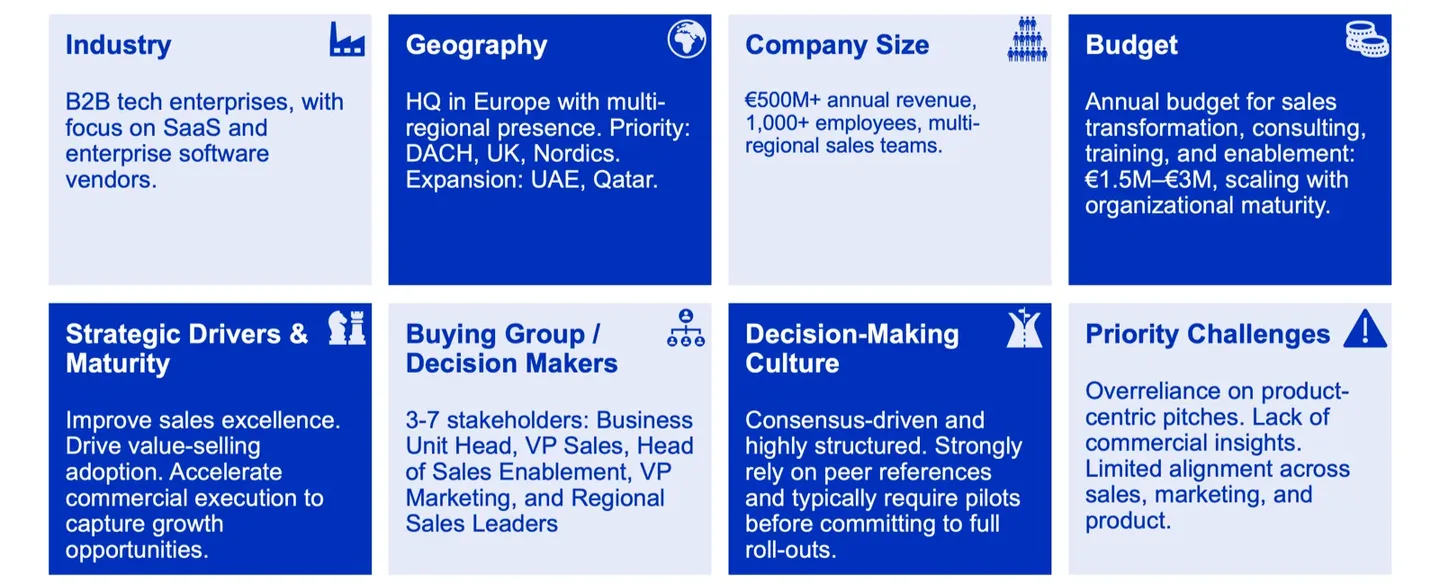
The goal is to make the ICP easy to use for daily execution:
- SDRs and sales reps use it for prospecting and inbound qualification
- Marketing uses it as the target audience for campaigns and outreach
2. Define Target Personas
List all personas within the ICP that influence the buying decision, including economic buyers, influencers, gatekeepers, and users.
Note: A customer persona is a semi fictional profile of a stakeholder in the buying process. It describes responsibilities, business objectives, KPIs, challenges, and decision criteria.
Step 2.1 - list personas
Capture all relevant personas. Remember to include stakeholders who are directly or indirectly impacted by the value proposition.
Step 2.2 - cluster personas
Group personas by their role in the buying group:
- Economic decision: Budget owner, final approval
- Business decision: Owns outcomes and adoption
- Technical decision: Owns architecture, security, integration
- Execution and user: Operates the solution and drives usage
- Governance: Procurement, legal, compliance
Step 2.3 - capture persona profile
For each persona, capture:
- Responsibilities: What the persona owns day to day, and what decisions they influence
- Business objectives: Measurable goals expressed with an action verb Objectives must be:
- Actionable
- Quantifiable
- Relevant
- KPIs: Metrics used to measure progress toward objectives
- Pain points and challenges: What prevents the persona from achieving objectives, including constraints, risks, and internal barriers
- Communication channels by funnel stage: Preferred channels by stage: awareness, consideration, decision
Step 2.4 - identify shared business objectives
In complex B2B deals, decisions are made by buying groups. Shared business objectives help align stakeholders around a common goal and create momentum.
Therefore, focus on the target personas that have at least one business objective in common.
Use shared objective to:
- Build messaging that resonates across roles
- Strengthen value propositions that support consensus
- Design commercial insights that mobilize the buying group
The goal of clearly defined target personas is to:
- Help sales understand who to target within ICP accounts, and tailor discovery and value messaging
- Help marketing define target audiences and create targeted content for campaigns
Step 2.5 - customer interviews
Validate the shared business objectives and learn how customers prioritize them.
Run structured interviews with existing and new customers. Select interviewees that match the identified target personas.
During each interview, ask the customer to:
- Rank each business objective on a 0 to 10 scale, then explain why
- Explain influencing factors and root causes that impact each objective, for example workforce, systems, investments, external constraints
This creates a clearer view of how customers see their own business model and what drives performance. The results of the interviews will be used to focus on the objectives and factors ranked highest across interviews.
3. Define Value Proposition
Define the vendor’s offering in simple, customer relevant language. Describe products, services, and capabilities based on customer problems and outcomes, not internal terminology.
Step 3.1 - describe each product or service
For each product or service considered for the GTM package, answer these guiding questions:
| Guiding question | What to capture |
|---|---|
| What is your product/service? | Describe your offering in one clear sentence without jargon. |
| What does your product / service do? | Top 2 to 3 customer problems your offering solves. |
| How does it work? (In simple terms) | High level explanation of how your offering work, non-technical. |
| What is the value to the customer? | Measurable outcomes and impact. |
Step 3.2 - select the GTM package
If multiple products exist, be selective.
- Choose the products and services with the highest customer value
- Package them as hero bundles, the lead offering to open doors and land first deals
- Treat remaining products and services as upsell opportunities
Step 3.3 - produce the value proposition statement
Create one concise statement that explains the offering through customer outcomes.
Use it as the base for:
- Marketing campaigns
- Sales pitches and presentations
- Product messaging and documentation
Step 3.4 - create a slogan or tagline
Use the answers to the guiding questions to craft a short slogan that summarizes the offering in a modern, engaging way.
A strong slogan:
- Aligns teams internally
- Makes the value instantly clear externally
Examples:
- Best in class sales methodology meets AI, for measurable B2B growth
- The value selling platform for tech companies to unlock predictable revenue
- Move from intuition to system for predictable revenue
4. Define Customer Mental Model
Visualize how the buying group connects success to execution, and execution to solutions.
The mental model connects:
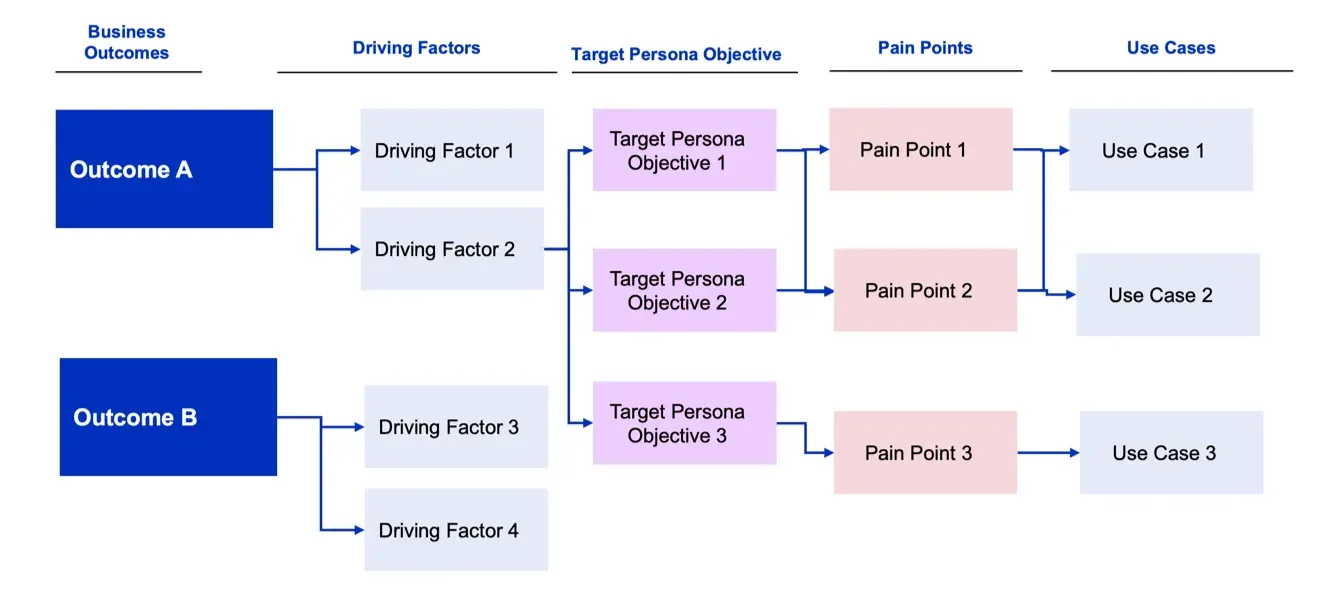
C level objectives → driving factors → target persona objectives → driving factors → pain points → use cases (in the form of required capabilities)
What the Mental Model is
The mental model is a customer led causal logic that links strategy to execution barriers, and then to the required capabilities needed to improve outcomes (use cases).
It keeps GTM narratives consistent because it starts with customer intent and introduces use cases as customer requirements, before any vendor offering is mapped.
Visualize the Mental Model
Use a mental map to show detailed cause and effect links across the buying group.
Build it left to right:
- C level objectives
- C level driving factors
- Target persona objectives
- Target persona driving factors
- Pain points
- Use cases (required capabilities) linked to hero bundles
How to build the Mental Model
- Capture C level objectives: List the strategic objectives leadership cares about.
- Define C level driving factors: For each objective, capture what must improve to achieve it.
- Add target persona objectives: List the shared objectives across target personas and link them to the relevant C level driving factors.
- Define target persona driving factors: Use interview insights to capture what drives achievement of each objective.
- Map pain points: List the pain points that block the objectives and link them to the objective or its driving factors.
- Map use cases: List the required capabilities (use cases) the customer needs to solve the pain points. Keep this vendor agnostic. Map hero bundles only after the mental model is complete.
- Map offering (hero bundles )to use cases: Map the vendor’s hero bundles to the use cases, and validate that each bundle supports a clear customer requirement.
Why it matters
The mental model clarifies how customers define success, what they believe drives it, and what blocks progress.
It also shows where to challenge assumptions and shift thinking, which creates differentiation and momentum.
5. Identify Unique Selling Points
Unique selling points, or USPs, are strengths only the vendor can claim, and that materially impact customer outcomes. They shape positioning and make the value proposition credible.
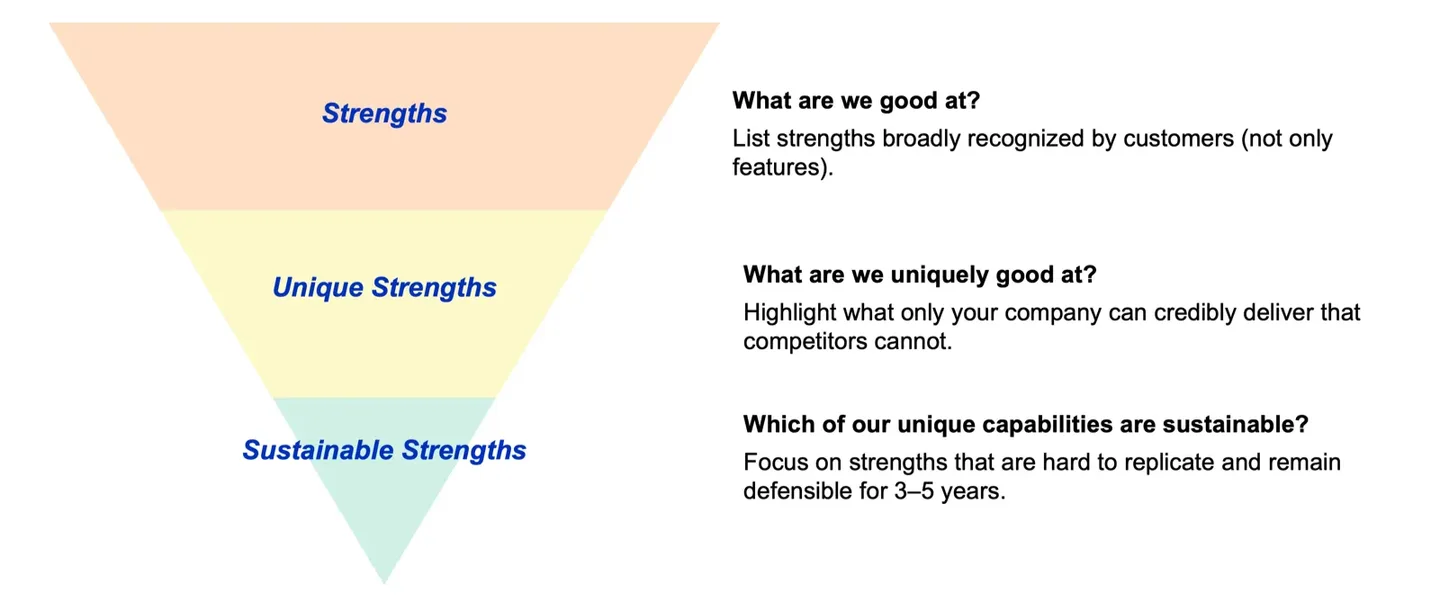
This is a filtering process. Start broad, then narrow down until only true USPs remain.
Step 5.1 - list strengths, broad set
- Ask: What are we good at
Go broad. Include product capabilities and also company capabilities.
For example:
- Domain expertise
- Services and delivery model
- Logistics and global coverage
- Partnerships and ecosystem
- Patents and IP
- R&D capability
- Data access, benchmarks, methodologies
- Financial stability and commercial flexibility
Step 5.2 - filter for uniqueness
- Ask: What are we uniquely good at
Remove anything competitors can claim as well. Keep only what is truly distinctive.
Step 5.3 - filter for sustainability
- Ask: Which unique capabilities are sustainable over time
Remove anything that is temporary or easy to copy. Keep what remains true over time and hard to replicate.
The output is a short list of USPs that are unique, valuable, defensible, and sustainable.
6. Define Commercial Insight
Creating a commercial insight is a structured thinking exercise. It translates customer understanding into a clear shift in perspective.
A commercial insight connects customer outcomes, the drivers behind those outcomes, and what the vendor can uniquely influence.
Step 6.1 - connect vendor USPs to the customer mental model
Start from the customer mental model created earlier.
Connect the vendor’s USPs to the key entities in the mental model:
- Outcomes and objectives
- Driving factors and root causes
- Pain points
- Use cases
Use these prompts:
- Are we different in the way we deliver the identified use cases, how
- Do we know something about outcomes or drivers that the customer does not, but should
- Are trends impacting outcomes or drivers in ways the customer has not recognized
Focus on the strongest 1 to 3 connections.
Step 6.2 - articulate consequence of inaction
Clarify what happens if the customer does not act on the insight and does not leverage the vendor’s USPs.
Capture:
- Risks that increase
- Opportunities that are missed
- Outcomes that stagnate
Use simple, concrete language.
Step 6.3 - back the insight with evidence
Support every commercial insight with credible proof, for example:
- Case studies and internal success stories
- Industry research and market trends
- Customer interviews and voice of customer inputs
- Benchmark data, regulatory, compliance insights
Step 6.4 - write the commercial insight statement
Produce a short statement that:
- Demonstrates understanding of the customer mental model
- Highlights why a different approach is needed to achieve outcomes
- Leads the customer to consider the vendor’s USPs as key for success
A strong commercial insight statement:
- Resonates across multiple personas
- Does not try to convince
- Does not mention products or services
7. Commercial Insight Continuous Validation and Adaptation
A commercial insight is a living asset. It must stay aligned with customer priorities, industry dynamics, and market signals.
Treat every interaction as a test.
Where to validate
Validate commercial insight in:
- Lead Generation (Milestone 0), campaigns and early prospect engagement
- Value Discovery (Milestone 1), live customer conversations
Track:
- Customer reactions
- Which messages resonate, which fall flat
- Objections and questions
- Whether the insight creates deeper engagement and a shift in thinking
How to collect feedback
Use a consistent feedback loop:
- Notes from discovery conversations
- Conversion metrics from insight led campaigns
- Objection patterns captured in CRM
- Win loss analysis
- Sales team reflections and field observations
Review inputs regularly and update the insight when needed.
How to adapt
Use the feedback to:
- Improve clarity and focus
- Remove outdated assumptions or claims
- Align messaging with new trends and customer priorities
Important note
Resistance is normal when an insight challenges beliefs.
Use pushback to:
- Share proof points and evidence
- Provide benchmarks and references
- Guide the customer with confident value based dialogue
Example
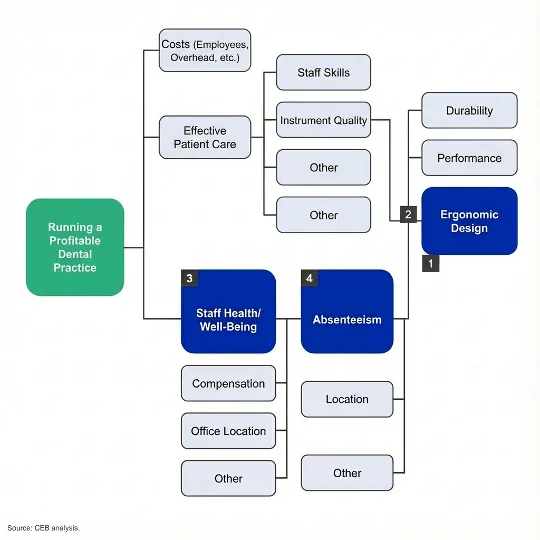
Below is a real example(from The Challenger Customer) of how a vendor of dental tools changed its GTM approach by replacing feature led selling with a customer mental model and a commercial insight: instead of leading with lightweight, ergonomic design, the vendor reframed the customer’s goal of running a profitable dental practice and made staff health and absenteeism the critical causal link between tooling decisions and financial performance.
Business objective
A dental practice owner aims to run a profitable dental practice.
How profitability is achieved
The main drivers that impact this business objective are:
- keeping costs under control
- effective patient care
- staff absenteeism
- location and other factors
What enables patient care and cost control
Key root causes behind staff absenteeism include:
- staff health and well being
- staff compensation
- location of the dental practice
- others
Reframing the customer way of thinking
- Staff of the dental practice spend a large share of the day holding and manipulating dental tools.
- Heavy or poorly balanced instruments increase biomechanical stress.
- Over time, this contributes to strain injuries such as carpal tunnel syndrome, tendonitis, and chronic wrist, hand, shoulder, and neck pain.
Consequently, staff needs to take medical leave, which causes absenteeism and negatively impacts the profitability of the dental practice.
Leading to the USP
- Dental tools that offer lightweight and ergonomic design help improve staff health
- which in return reduces absenteeism
- and positively impacts the profitability of the dental practice
The Commercial Insight Statement
Lighter, well balanced, ergonomically designed tools reduce strain, lower injury risk, and support sustainable clinician performance.
Summary
- Profitability requires stable revenue and controlled costs.
- Stable revenue and controlled costs require consistent clinician availability and low absenteeism.
- Low absenteeism requires strong staff health and well being, especially protection against repetitive strain injuries.
- Staff health is materially affected by daily exposure to heavy or poorly balanced dental tools.
- Selecting ergonomic, lighter instruments reduces strain, lowers injury risk, decreases absenteeism, stabilizes revenue, and limits staffing cost spikes.
This chain reframes ergonomic dental tooling from a feature choice into a business lever: a practical investment to protect clinician capacity and improve profitability.
Quality Gates
- All GTM foundations are defined and aligned across sales, marketing, and product
- Commercial insight is validated at least once through a real customer conversation
- Commercial insight is tested in at least one Lead Generation campaign, with engagement metrics reviewed and captured
Sales Enablement Artifacts
Register for free on the Value Accelerator website to download templates and tools that support execution of this Milestone.
Sales enablement artifacts. The templates, canvases and calculators for this milestone are free to download.
Get the GTM Foundation toolkit