

Introduction
Value Narratives (Milestone -1) is part of the GTM Setup Phase of the Value Accelerator GTM Blueprint.
This milestone is mandatory. It turns the foundations defined in GTM Foundation (Milestone -2) into insight-led messaging that marketing and sales can reuse across campaigns and customer engagements.
This milestone is not executed per customer. It is executed at product or industry level, typically once per year, or when:
- Launching a new offering
- Repositioning the value proposition
- Entering a new market, addressing new customer segments
This Milestone must be completed before engaging individual customer opportunities and it requires collaboration across sales, marketing, and product teams to align on one shared direction.
Purpose
The Value Narratives Milestone turns the output of GTM Foundation (Milestone -2) into market facing execution.
GTM Foundation (Milestone -2) answered the question where to play, the target markets the vendor is best suited to address, and the target personas within the ICP most impacted by the offering.
The Value Narratives Milestone answers the question how to play, how to engage those target personas from a marketing and sales perspective, across the full funnel.
This Milestone ensures one consistent narrative is conveyed to the market across marketing and sales. The narrative is anchored in customer value and outcomes, not in the product, services, or the vendor.
Value Narratives Milestone defines:
- The overall narrative the vendor should push into the market to earn a clear strategic positioning
- The content strategy and content set required to activate the narrative across the different stages of the marketing funnel (TOFU, MOFU, and BOFU)
- The outreach strategy design, including channels, cadence, and SIC sequencing logic
Methodology
Value Thread
The value thread is a structured way to connect customer priorities to use cases and offerings in a consistent, outcome led way.
Its purpose is to ensure that market messaging does not start from products or features. Instead, every message can be traced back to a business outcome the buying group cares about, and to the execution barriers that block that outcome today.
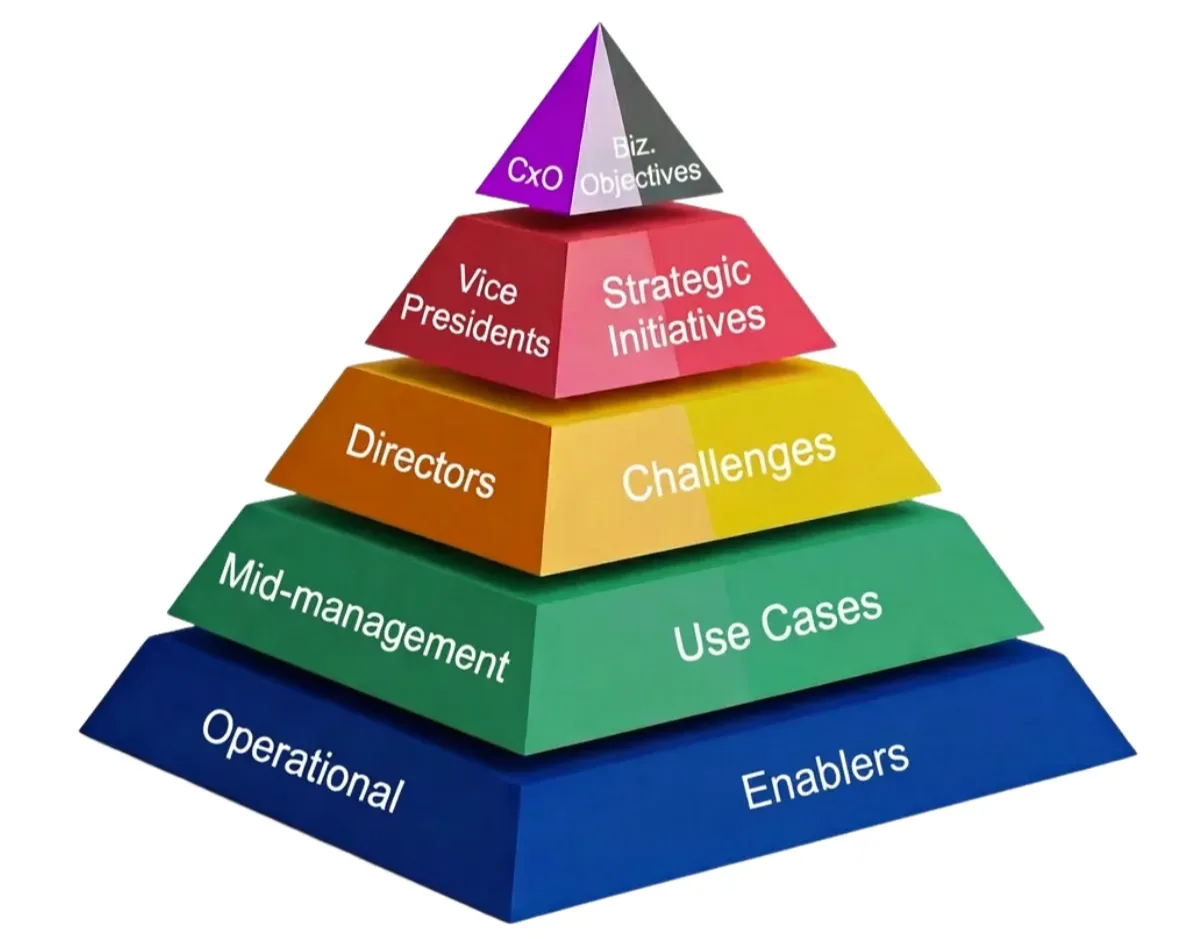
The value thread is built as a top down chain:
- Business objectives: What leadership defines as success.
- Strategic initiatives and KPIs: How leadership measures progress and drives action.
- Challenges and root causes: What prevents initiatives from being achieved, focusing on root causes rather than symptoms.
- Use cases: the way how customer can leverage specific capabilities to address the challenges..
- Enablers: Products and services positioned as enablers of the use cases, not as the starting point.
The value thread is informed by the customer mental model defined in the previous Milestone. It translates the customer’s current logic into a vendor designed narrative structure that can be reused across positioning, campaigns, and sales assets.
Strategic Messaging Architecture
The strategic messaging architecture is the method used to translate the value thread into a coherent value-based market narrative.
It provides guidance on how to create value based copy that can be reused across all channels.
It defines the sequence and altitude of messages the vendor should push into the market, from C level relevance to commercial action.
It ensures that:
- messaging starts from outcomes and execution reality
- each level earns the next level
- offerings appear only after the case for change is established
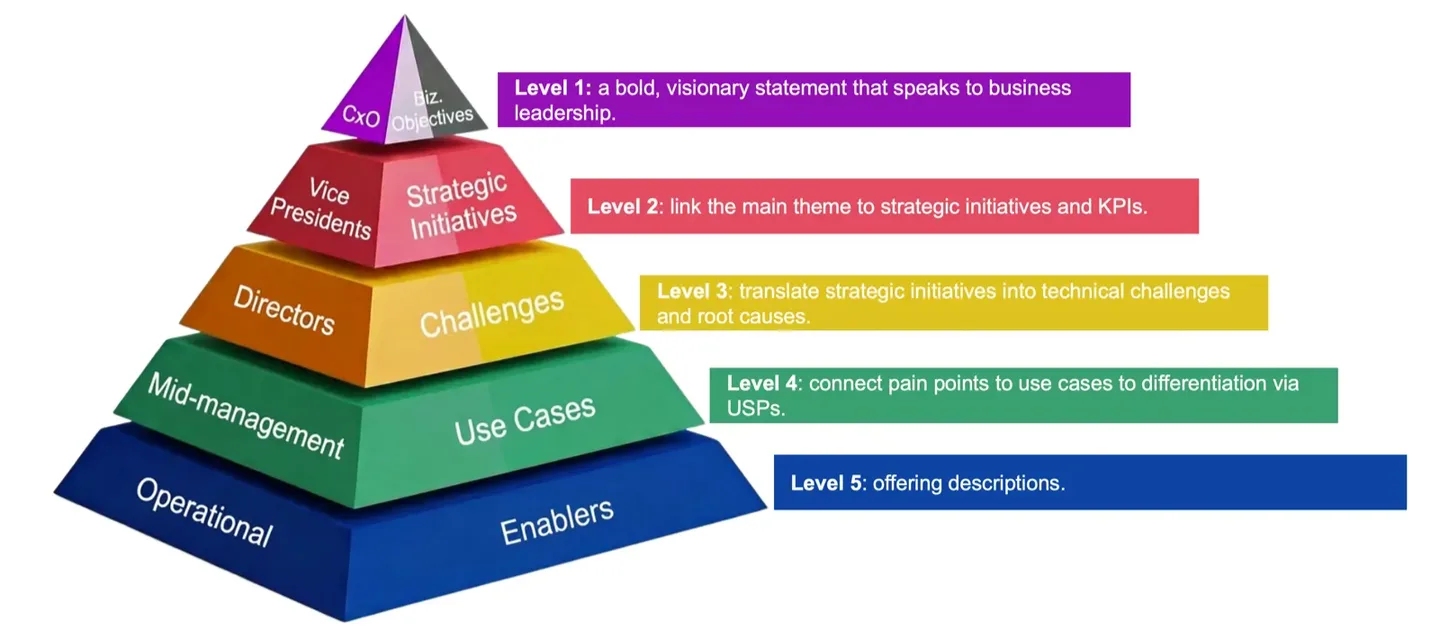
The messaging architecture has five levels:
- Level 1: strategic main theme
- Level 2: strategic initiatives and KPIs
- Level 3: challenges and root causes
- Level 4: use cases and differentiation
- Level 5: Enablers (products and services)
Level 1 - strategic main theme
The main theme is a bold, visionary statement that speaks to business leadership.
It must begin from a strategic lever that leadership cares about, for example profitability, differentiation, growth, resilience, or risk management.
The main theme:
- reframes how success is defined
- ties competitive advantage to a strategic lever
- creates leadership level relevance without mentioning offerings
It is not a slogan or campaign headline.
It is the strategic spine of the narrative.
Level 2 - strategic initiatives and KPIs
This level explains why the main theme matters in execution terms.
Messaging connects the main theme to:
- the strategic initiatives leadership cares about
- the KPIs used to measure success
- the trade offs customers face today
The goal is to build credibility and relevance by showing that the main theme is not abstract, it directly impacts how leadership measures progress and drives action.
Level 3 - challenges and root causes
This level translates strategic intent into execution reality.
Messaging reveals:
- the challenges blocking progress
- the root causes behind underperformance
- why these issues matter now, in business terms
This is where technical or operational topics can be introduced, but they must be framed as business impact.
This level aligns with the Introduce intent in SIC, turning the strategic theme into a clearer understanding of what is really driving the problem.
Level 4 - use cases and differentiation
At this level, the narrative shifts from what is wrong to what must be done.
Messaging introduces:
- the use cases required to remove the challenges
- the criteria that define a strong approach
- the vendor’s unique capabilities as differentiation, without leading with products
Each challenge should connect to:
- a use case
- a vendor capability
- a USP
This is where buyers start forming preferences, because the narrative becomes actionable and the differentiation becomes credible.
Level 5 - Enablers (products and services)
Only after the previous levels are established do products and services appear.
They are positioned as:
- enablers of the use cases
- proof of execution capability
- risk reduction mechanisms
Each product or service should be described by:
- what it does
- how it works at a high level
- what value it unlocks
Descriptions must link back to target persona objectives and to the main theme.
Products do not create the value story.
They complete it.
Three-stage marketing funnel
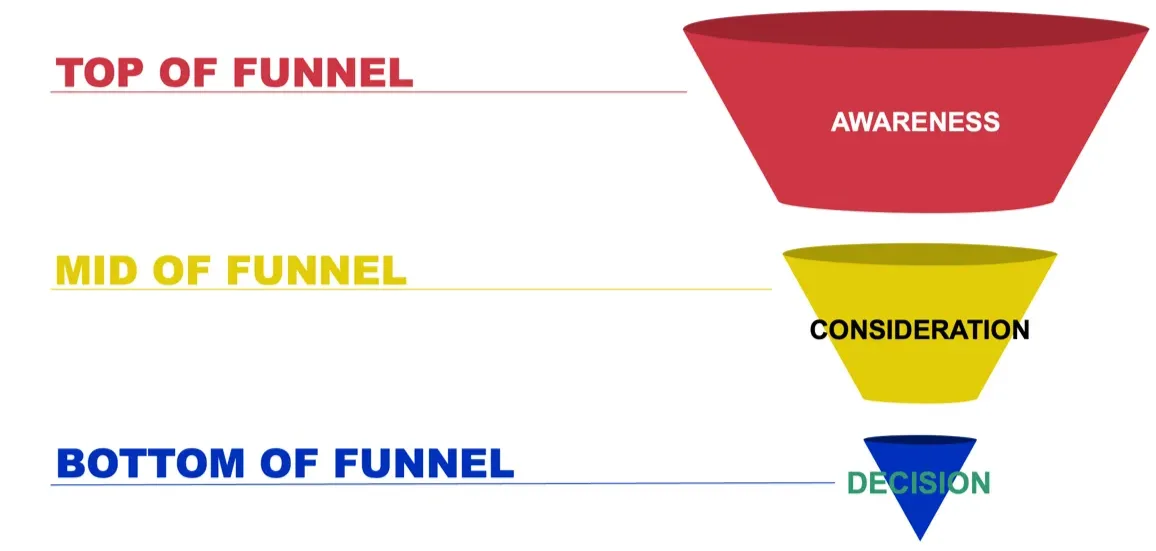
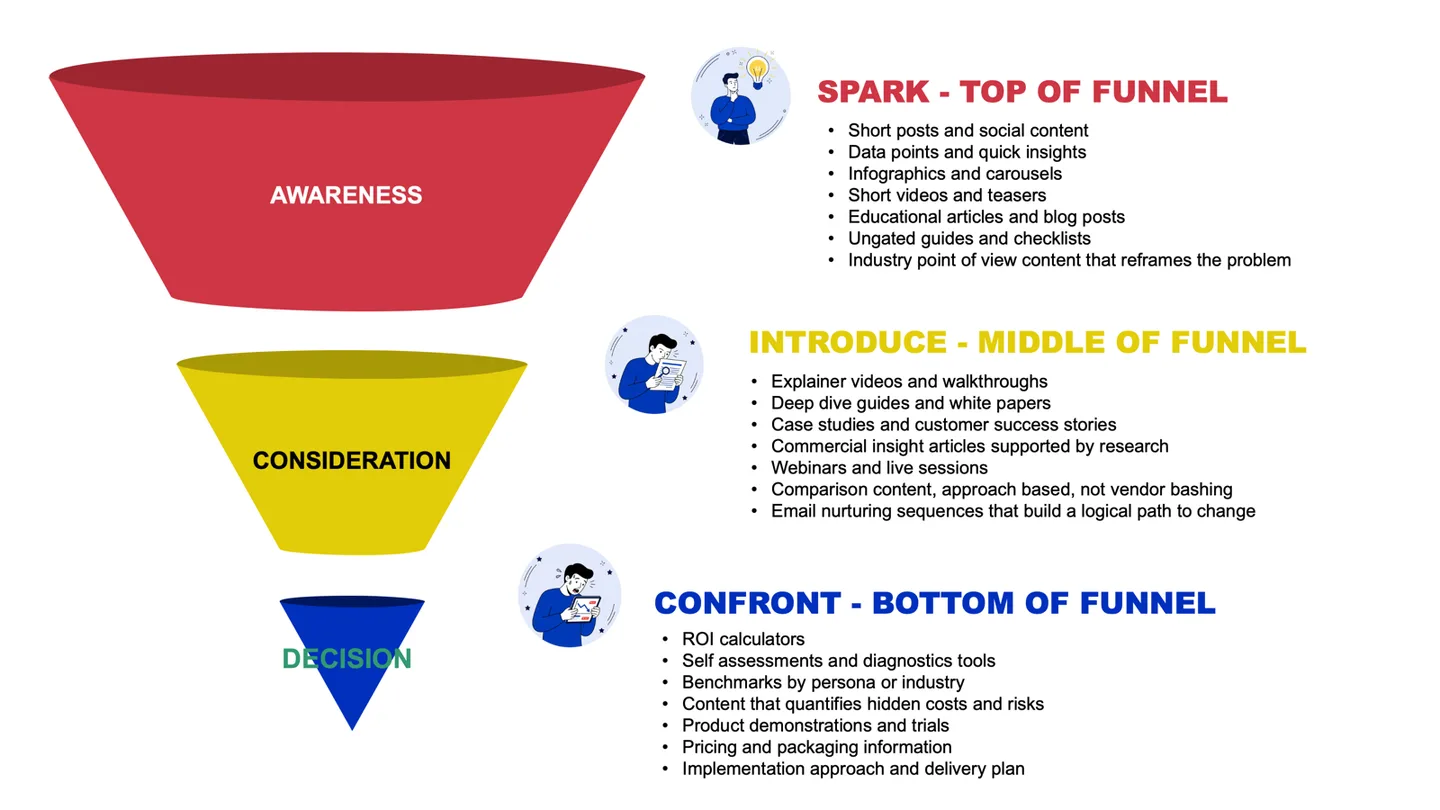
The three-stage marketing funnel is a simple model that explains how buyers move from early awareness to a purchase decision.
It helps teams choose the right message and content for each stage, so marketing and sales engage the buying group with the right intent at the right time.
Top of funnel (TOFU) - awareness
At TOFU, prospects are learning about a problem or opportunity.
They are not looking for vendors yet. They are looking for clarity.
Middle of funnel (MOFU) - consideration
At MOFU, prospects agree the problem matters and start evaluating different approaches.
They compare options and try to understand what good looks like.
Bottom of funnel (BOFU) - decision
At BOFU, prospects shortlist vendors and prepare for a decision.
They look for proof, risk reduction, and confidence in execution.
SIC Framework for Marketing Content
The SIC Framework, introduced in The Challenger Customer, is the method used to design insight led content that shifts customer thinking and creates demand for change.
It works as a sequence of messages that guide the customer learning journey.
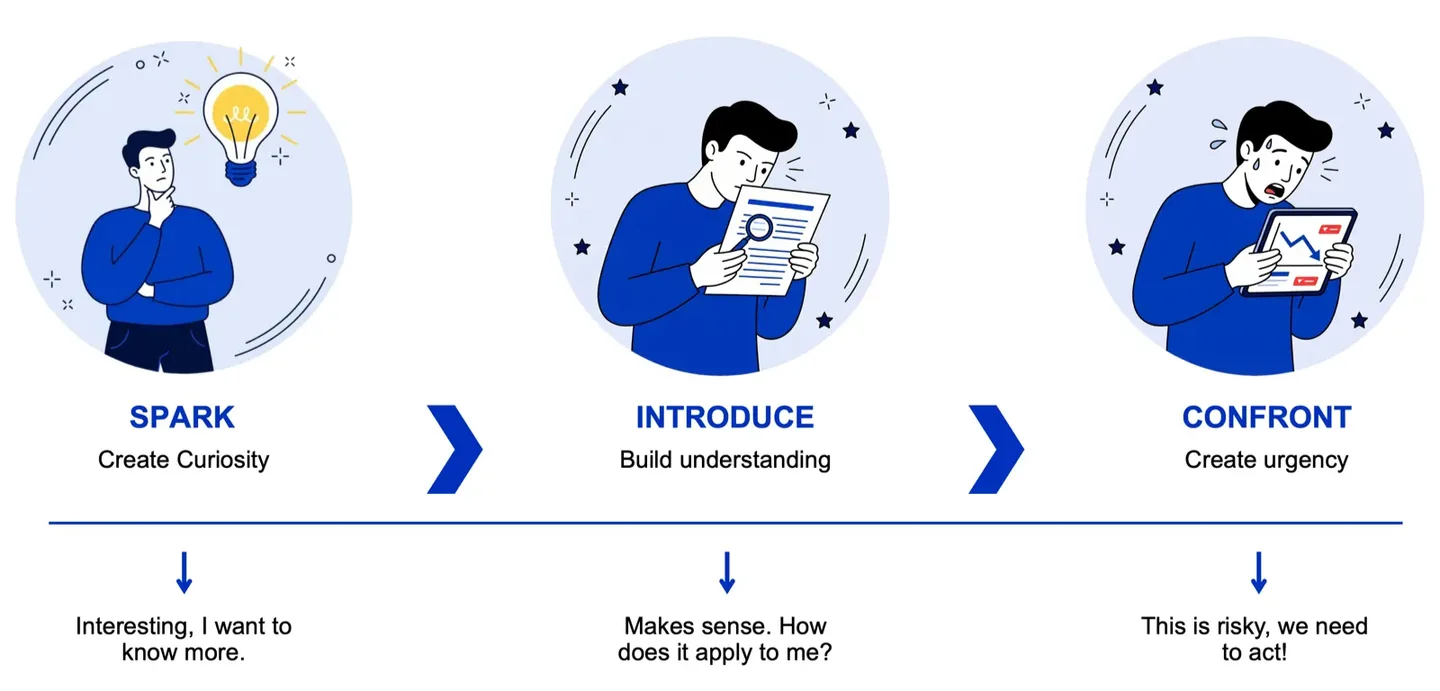
The SIC Framework has three stages:
- Spark
- Introduce
- Confront
Each stage serves a different intent and builds on the same commercial insight, so the message stays consistent while depth increases.
Spark - create curiosity
Spark content challenges assumptions and creates curiosity.
It is light, easy to consume, and vendor agnostic. The goal is attention and interest, not conversion.
Desired reaction:
This is interesting, worth exploring.
Introduce - build understanding
Introduce content explains the problem more deeply.
It adds context, proof, and examples to help the customer connect the insight to their reality.
It stays focused on the problem and why change matters, not on the vendor.
Desired reaction:
This makes sense, how does it apply to our situation.
Confront - create urgency
Confront content makes the cost of inaction clear.
It brings the insight closer to the customer context, using data, benchmarks, and quantified impact.
The goal is to trigger action and open a sales conversation, not to push a product.
Desired reaction:
This is a real risk, change needs to happen.
Design principle
Spark, introduce, and confront must be built around the same commercial insight.
Only the depth and level of personalization changes.
This keeps marketing and sales aligned and creates a clear, progressive path from awareness to action.
Content Strategy - marketing funnel and SIC Framework combined
A content strategy is designed after the overall narrative is defined.
The narrative defines what the vendor wants the market to believe, and why change matters. Once that narrative is available, the content strategy translates it into a structured set of assets that can be deployed across channels and reused by marketing and sales.
A content strategy has a clear target.
It is built for the target personas defined in Milestone -2, meaning the specific stakeholders in the buying group that the vendor wants to influence. Each asset is designed to move these personas through a learning journey, not to broadcast generic thought leadership.
In the Value Accelerator GTM Blueprint, the content strategy is generated by combining two concepts:
- The three stage marketing funnel defines when the target personas are ready for a certain type of message, from early awareness to purchase intent
- The SIC Framework defines how the target personas must think differently before they can engage commercially, from curiosity to urgency
These two models work together as a simple mapping:
- TOFU aligns with Spark
- MOFU aligns with Introduce, and starts preparing for Confront
- BOFU aligns with Confront, and enables action
Combined, they ensure that content progresses logically from early relevance to justified action, with consistent messaging that marketing and sales can reuse across touchpoints.
TOFU and Spark - create relevance with target personas
At the top of the funnel, the goal is relevance, not conversion.
Spark content is designed to reach the target personas and earn attention. It challenges a common assumption that shapes how these personas interpret priorities and risk, so the narrative feels immediately relevant.
At this stage, messaging avoids offerings, use cases, and technical detail.
- Primary role: Create awareness and challenge high level assumptions
- Funnel stage: TOFU
- SIC stage: Spark
Typical content:
- Short posts and social content
- Data points and quick insights
- Infographics and carousels
- Short videos and teasers
- Educational articles and blog posts
- Ungated guides and checklists
- Industry point of view content that reframes the problem
MOFU and Introduce - build understanding and conviction with target personas
In the middle of the funnel, the goal is conviction.
Introduce content helps the target personas understand the problem more deeply and in a way they can share internally. It expands the narrative with proof, examples, and clear logic, so the personas can connect what they see in the market to what they experience in their own context.
This is also where Confront preparation starts, by making the risk and cost directionally clear, without pushing a decision.
- Primary role: Educate, reframe, and build conviction
- Funnel stage: MOFU
- SIC stage: Introduce, progressing toward Confront
Typical content:
- Explainer videos and walkthroughs
- Deep dive guides and white papers
- Case studies and customer success stories
- Commercial insight articles supported by research
- Webinars and live sessions
- Comparison content, approach based, not vendor bashing
- Email nurturing sequences that build a logical path to change
BOFU and Confront - create urgency and enable action with target personas
At the bottom of the funnel, the goal is action.
Confront content makes the cost of inaction tangible for the target personas and supports a buying decision. It brings the narrative into their decision context, quantifies impact, and reduces perceived risk.
Only at this stage are use cases and offerings introduced, positioned as practical ways to act and supported by evidence that increases confidence in execution.
- Primary role: Drive decision making and commercial engagement
- Funnel stage: BOFU
- SIC stage: Confront
Typical content:
- ROI calculators
- Self assessments and diagnostic tools
- Benchmarks by persona or industry
- Content that quantifies hidden costs and risks
- Product demonstrations and trials
- Pricing and packaging information
- Implementation approach and delivery plan
Results of a strong content strategy
- Every message has a clear intent by funnel stage
- Spark, introduce, and confront build on the same commercial insight, with increasing depth
- Marketing and sales reuse the same logic across campaigns and conversations
- Target personas experience content as insight led, not promotional
This is the difference between content that fills channels and content that moves markets.
Refer to Sales Enablement Artifacts for supporting materials.
Execution
To execute the Value Narratives Milestone, complete these activities:
- Create Value Narrative
- Define Marketing Outreach Strategy
- Create Marketing Content
- Create cold outreach templates
This Milestone is driven by marketing, with active input from sales and product to ensure the narrative and content stay aligned with the commercial insight and the target personas defined in GTM Foundation (Milestone -2).
Detailed instructions for each activity are provided in the sections below.
1. Create Value Narrative
The purpose of this activity is to produce the market narrative that marketing and sales will reuse across channels, campaigns, and customer interactions. The narrative is built around the validated commercial insight and target personas defined in GTM Foundation (Milestone -2).
Step 1.1 build the value thread
Create the value thread using the customer mental model as input.
Document the value thread as a complete chain from business objectives down to offerings, with clear links between each layer.
Step 1.2 create the narrative using the strategic messaging architecture
Translate the value thread into narrative copy using the five messaging levels:
- Level 1: strategic main theme
- Level 2: strategic initiatives and KPIs
- Level 3: challenges and root causes
- Level 4: use cases and differentiation
- Level 5: products and services
Step 1.3 define Level 1: strategic main theme
Write the main theme as a single, bold statement.
Ensure the theme:
- is anchored in a strategic lever leadership cares about
- creates relevance without mentioning offerings
- can be reused consistently across channels
Step 1.4 define Level 2: strategic initiatives and KPIs
Describe the initiatives and KPIs that make the main theme real in execution terms.
Capture the trade offs and constraints leadership must manage.
Step 1.5 define Level 3: challenges and root causes
List the challenges blocking progress and the root causes behind them.
For each item, document why it matters now in business terms.
Step 1.6 define Level 4: use cases and differentiation
For each challenge, document:
- the use case required to remove it
- the capability that enables the use case
- the USP that makes the approach differentiated and credible
Step 1.7 define Level 5: products and services
For each offering, document:
- what it does
- how it works at a high level
- what value it unlocks for the target personas
Ensure every description links back to the narrative logic established in Levels 1 to 4.
Output
The output of this activity is a complete value narrative document that includes:
- the five level narrative structure
- final copy for each level
- explicit links from challenges to use cases to USPs and offerings
- the validated commercial insight the narrative is built around
This output becomes the input for the next execution step, where the narrative is converted into full funnel assets using the three stage marketing funnel and the SIC Framework.
2. Define Marketing Outreach Strategy
The outreach strategy defines how marketing and sales engage the target personas early, before there is an inbound request.
It sets:
- the channels used to reach the target personas
- the touchpoint cadence per lead
- how each touchpoint aligns to the commercial insight and the SIC progression
An effective outreach strategy is required to trigger early engagement and test the resonance of the commercial insight.
Cold outreach is still a numbers game. It takes consistent volume to create enough reach. The difference is that volume must be directed at the ICP and target personas, and every touchpoint must carry the same insight-led logic.
Step 2.1 select the right channels
Outreach must happen where the target personas already spend time and engage with professional topics.
The core outreach channels are:
- Cold calling
- Best for real time feedback and fast qualification. It helps validate message resonance quickly and adapt the commercial insight based on what lands and what gets rejected.
- KPIs: call volume, connect rate, qualified conversation rate, meeting booked rate, recurring objections and proof points captured
- Cold email
- Best for scalable sequencing and structured testing. It supports clear SIC progression, while open, click, and reply signals indicate which messages create traction.
- KPIs: delivery rate, open rate, click rate, reply rate, positive reply rate, meeting booked rate
- LinkedIn messages
- Best for persona based personalization and credibility through context. It reinforces familiarity and increases response rates when used alongside calling and email.
- KPIs: connection acceptance rate, response rate, positive response rate, meeting booked rate
Select a channel mix based on the ICP and persona habits.
The goal is a multi touch, multi format campaign that reuses the same narrative across channels.
Step 2.2 define the outreach cadence
Define a short sequence per lead.
Each touchpoint must serve one clear intent and follow the SIC progression around the same commercial insight.
Recommended 5 touch-points:
- Spark: Short message that creates curiosity
- Introduce - quantitative: Data point, benchmark, infographic
- Introduce - qualitative: Customer story or market example
- Confront: Self assessment, ROI view, risk checklist
- Close: Respectful final message that leaves the door open
Refer to the Sales Enablement Artifacts below for details.
3. Create Marketing Content
This activity creates the content assets marketing will use for outreach and nurturing.
Content is created after the value narrative is defined.
Every asset must align to the same commercial insight and follow the SIC progression, so the message stays consistent while depth increases.
Step 3.1 define the content set per SIC stage
Create a focused set of assets for each stage:
- Spark: Create curiosity and motivate engagement.
- Introduce: Deepen understanding with evidence, examples, and reasoning.
- Confront: Make the cost of inaction tangible and justify a next step.
All stages must be built around the same commercial insight.
Step 3.2 Keyword strategy
SIC content reframes the problem, but discoverability still depends on current customer language:
- Capture the terms customers use today
- Align titles and descriptions to those terms
- Use the content to introduce the new framing gradually
Step 3.3 design content for the target personas
Use the target personas defined in Milestone -2 as the audience for all content.
Content must work across the buying group, not only for one role.
The goal is to support internal alignment by making the problem and the need for change clear in consistent language.
Step 3.4 select formats that match channels
Create assets that can be deployed through the outreach channels, for example:
- Email copy and follow ups
- Call openers and call scripts
- LinkedIn posts and direct messages
- Short videos, visuals, landing pages
Content Guidelines
Quality checks:
- Customer first: Customer outcomes, constraints, and decision logic, not vendor language.
- Commercial insight led: Every asset conveys, reinforces, or prepares the commercial insight.
- Buying group consistency: One narrative across personas and functions.
- Progressive depth: Spark creates curiosity, Introduce builds understanding, Confront justifies action.
Content to avoid:
- Product or feature promotion without a case for change
- Generic industry content not connected to the commercial insight
- Vendor centric event content that starts from demos
- Broad thought leadership with no tension or consequence
Content design principles:
- Add simple sharing mechanisms when relevant
- Use gated assets selectively to create progress from Spark to Introduce to Confront
- Tag assets by SIC stage so performance can be tracked and improved
4 Create cold outreach templates
The purpose of this activity is to prepare the outreach assets that marketing and sales will reuse to engage the buying group with one consistent narrative, across channels and touchpoints.
Templates must use common language that speaks across the target personas identified in Milestone -2.
The goal is not persona specific scripting, it is buying group consistency, so different stakeholders can recognize the same problem, share the message internally, and align faster.
Step 4.1 prepare templates for the core outreach channels
Create templates for the outbound channels identified in the outreach strategy, e.g.:
- Cold calling script
- Cold email copy
- LinkedIn message copy
All templates must stay anchored in one commercial insight and one narrative, so the buying group experiences a coherent message regardless of channel.
Refer to the Sales Enablement Artifacts below for details.
Step 4.2 design templates for A / B testing
Cold outreach is a numbers game, so improvement comes from structured testing, not from rewriting the narrative every week.
Prepare A / B variants for the elements that most influence engagement:
- Cold call opener
- Version A challenges a common assumption
- Version B highlights the consequence of inaction
- Email subject line
- Version A is outcome focused
- Version B is tension focused
- Proof type
- Version A uses one quantitative proof point
- Version B uses one qualitative example
Keep the commercial insight unchanged. Only test framing and proof, so results stay comparable and the message remains consistent across the buying group.
Quality Gates
- Strategic positioning is defined, documented, and aligned across marketing, sales, and product
- A complete set of value based content assets is produced and mapped to Spark, Introduce, and Confront
- Outreach strategy is defined, including channels, cadence, and touchpoints aligned to one commercial insight
Sales Enablement Artifacts
Register for free on the Value Accelerator website to download templates and tools that support execution of this Milestone.
Sales enablement artifacts. The templates, canvases and calculators for this milestone are free to download.
Get the Value Narratives toolkit