

Introduction
Milestone 3: Value Design Workshop is part of the GTM Execution Phase of the Value Accelerator GTM Blueprint.
This is an optional Milestone.
In small or transactional engagements, where only a limited set of stakeholders is involved, this Milestone is often not required.
In complex enterprise engagements, where multiple decision makers, mobilizers, and influencers shape the outcome, this Milestone is strongly recommended.
This Milestone consists of a value based workshop that guides the buying group through a structured decision making process. Its purpose is to align stakeholders on a shared understanding of the problem, the recommended approach, and the path forward, reducing ambiguity and increasing collective commitment.
Purpose
The Value Design Workshop is a critical tool for managing complexity in large-scale customer engagements.
When multiple stakeholders are involved in a buying decision, reaching consensus on what problem to solve and how to solve it becomes a major challenge.
Key obstacles in enterprise deals:
- Unclear problem priority: Different stakeholders prioritize different issues, so the buying group struggles to agree on what problem matters most.
- Competing solution preferences: Lack of alignment across the buying group on the right solution strategy
The Value Design Workshop is designed to address these challenges.
It creates a structured environment for stakeholder alignment and decision making, enabling the customer organization to move forward with clarity and confidence.
Through this Milestone, the vendor facilitates a collaborative session where customer stakeholders align on:
- Business strategy: Shared understanding of overarching goals and strategic priorities
- Top challenges: Agreement on the most pressing barriers impacting performance
- Solution definition: Agreement on the direction and principles of the recommended approach
By helping customers make sense of their internal complexity, the vendor becomes a facilitator of consensus, not only a provider of solutions.
Research from The Challenger Customer shows that vendors who reduce decision making complexity for buying groups are 62 to 70% more likely to close high quality deals.
It also shows that sales reps who act as decision facilitators increase the likelihood of long term partnership by 23%.
The Value Design Workshop is a strategic move to accelerate decisions, reduce deal risk, and strengthen the vendor position as a trusted partner.
Methodology
Collective Learning
At the core of the Value Design Workshop is a structured method based on Collective Learning.
In The Challenger Customer, Collective Learning is described as one of the most effective ways for large customer organizations to overcome internal misalignment and reach alignment on complex decisions. It happens when stakeholders learn together by comparing perspectives, debating what matters, and building agreement through interaction.
In complex B2B buying situations, stakeholders often operate in silos, pursue competing priorities, or lack clarity on how their objectives connect.
Collective Learning helps bridge these gaps by creating shared context, shared language, and shared ownership of the decision.
The Value Design Workshop is designed to enable this process.
It brings the buying group into a guided session facilitated by the vendor, with the goal of helping the group reach clarity on the problem, the recommended approach, and the path forward.
During the workshop, the vendor enables Collective Learning by encouraging:
-
Open dialogue Create a safe environment where stakeholders can voice assumptions, concerns, and constraints.
-
Collaborative problem solving Guide the group to converge on the right problem priority and explore solution paths together.
-
Shared understanding Help participants express a common direction that aligns with business strategy and success criteria.
When done well, the Value Design Workshop becomes a catalyst for internal alignment, which is often the deciding factor in large enterprise deals.
Signs that Collective Learning is happening include:
- Candid discussion about conflicting priorities or misunderstandings
- Stakeholders acknowledging that perspectives differ, without shutting the debate down
- Active exploration of interdependencies across functions and teams
- Joint development of solution principles and evaluation criteria
- Objections being addressed collaboratively, not handled in isolation
These behaviors signal progress, not dysfunction.
They show that the buying group is maturing its decision and moving toward aligned action.
The vendor role is to guide the process, not dominate the conversation, helping the group uncover the shared consensus that enables a confident collective decision.
Value Threads
A central concept used in the Value Design Workshop is the Value Thread.
The Value Thread was originally introduced in Milestone -1 as a model to understand how target personas think about value, and to derive from it the value narrative for strategic market positioning.
The Value Thread links five elements:
- Business objectives: The strategic outcomes the C-level wants to achieve.
- Strategic initiatives and KPIs: The programs designed to achieve those objectives, and the metrics used to measure progress.
- Challenges: The obstacles preventing initiatives from succeeding.
- Use cases: how the customer organization can leverage specific capabilities to address the challenges
- Enablers (Product and Services): The vendor products and services required to implement the use cases.
In the context of Milestone 3, the Value Thread is applied during complex B2B customer engagements, where different stakeholders care about different parts of the value chain:
- C level executives focus on business objectives and strategic direction
- Vice presidents focus on initiatives and KPIs that drive execution
- Directors and middle managers focus on challenges that block progress
- Specialists and operational roles focus on use cases and implementation details, including the required products and services
In Milestone 3, the Value Thread is used to ensure that customer workshops are relevant to each customer stakeholder, while maintaining one cohesive storyline. Business and technical topics stay connected, and every conversation remains anchored in value creation.
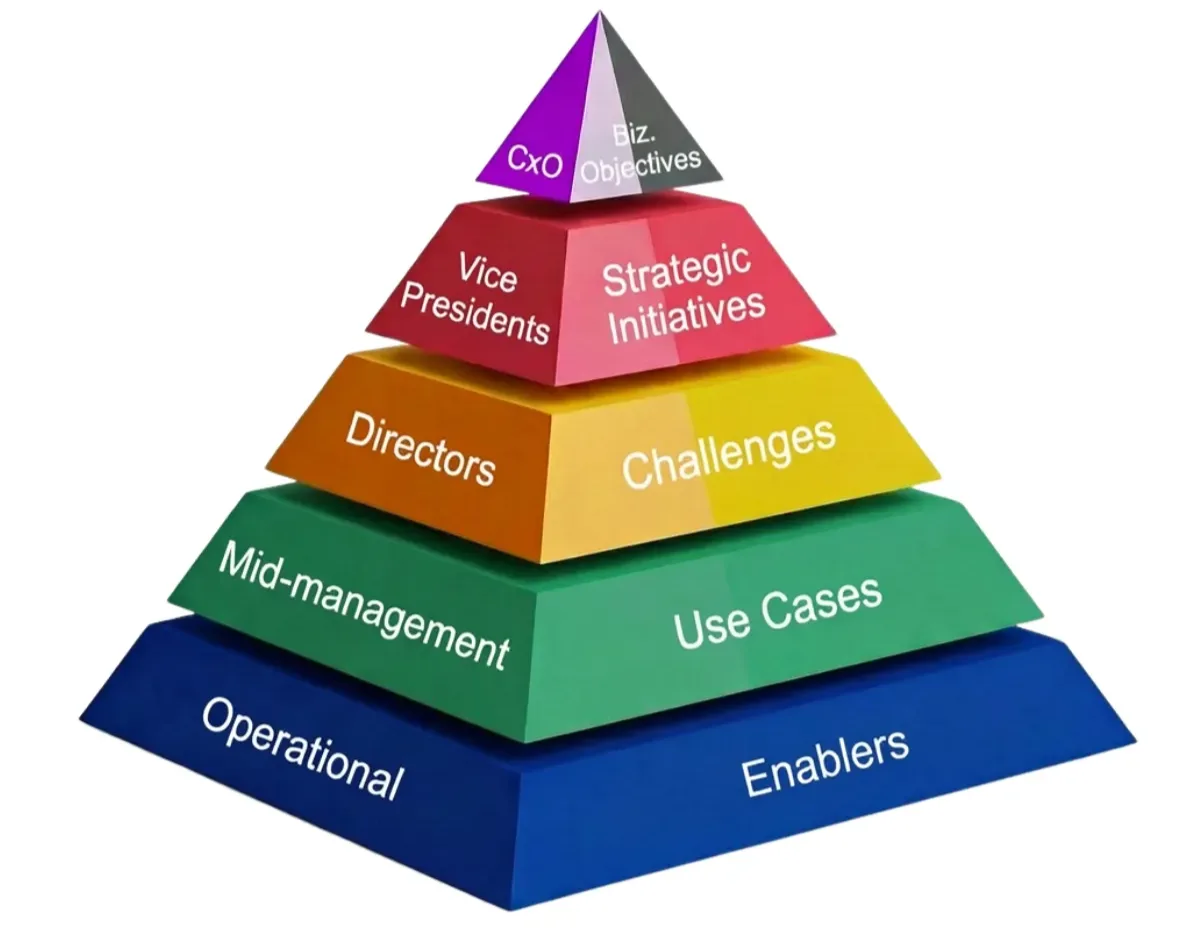
Example of a Value Thread
| Element | Definition | Example |
|---|---|---|
| Objective | A strategic business outcome set by senior leadership. | “Reduce energy consumption across all manufacturing sites by 30% by 2030.” |
| Initiative and KPI | A program with measurable outcomes to realize the objective. | “Implement energy monitoring systems in all sites by 2026.” KPI: percentage of sites with an energy monitoring system live |
| Challenge | A blocker preventing execution of the initiative. | “Facility managers lack real time data on energy usage at the equipment level.” |
| Use case | A specific solution that addresses the challenge. | “Deploy sub metering and edge analytics to monitor energy consumption in real time.” |
| Enabler | The vendor offering required to implement the use case. | “Vendor edge devices, energy manager software as a service, and commissioning services.” |
The Value Thread also serves as a diagnostic tool to assess customer maturity by evaluating how clearly the customer can articulate each dimension.
| Maturity indicator | What to look for |
|---|---|
| Strategic maturity | Can long term objectives be stated clearly, including why they matter? |
| Tactical maturity | Are initiatives defined and active, with KPIs that are tracked and used? |
| Execution clarity | Are challenges known, agreed, and prioritized across stakeholders? |
| Solution readiness | Are technical capabilities and use cases identified, owned, and connected to specific challenges? |
| Procurement and delivery readiness | Are enablers already mapped, requested, or constrained by standards and integration needs? |
This diagnostic helps the vendor:
- Adapt the workshop flow to the customer maturity level
- Adjust language and depth by stakeholder group
- Support less mature customers by defining missing elements
- Accelerate mature customers by refining decisions and fast tracking execution
When the customer stakeholders can clearly articulate each dimension of the Value Thread, the workshop should focus on refining the existing strategy and improving execution quality.
When one or more dimensions are vague or missing, the workshop should focus on clarifying priorities and connecting perspectives across functions, before moving into solution detail.
Workshop Methodology
The customer workshop conducted in this Milestone follows a structured methodology developed by the Value Accelerator.
It combines proven industry practices with a distinctive approach designed to create stakeholder alignment in complex B2B environments.
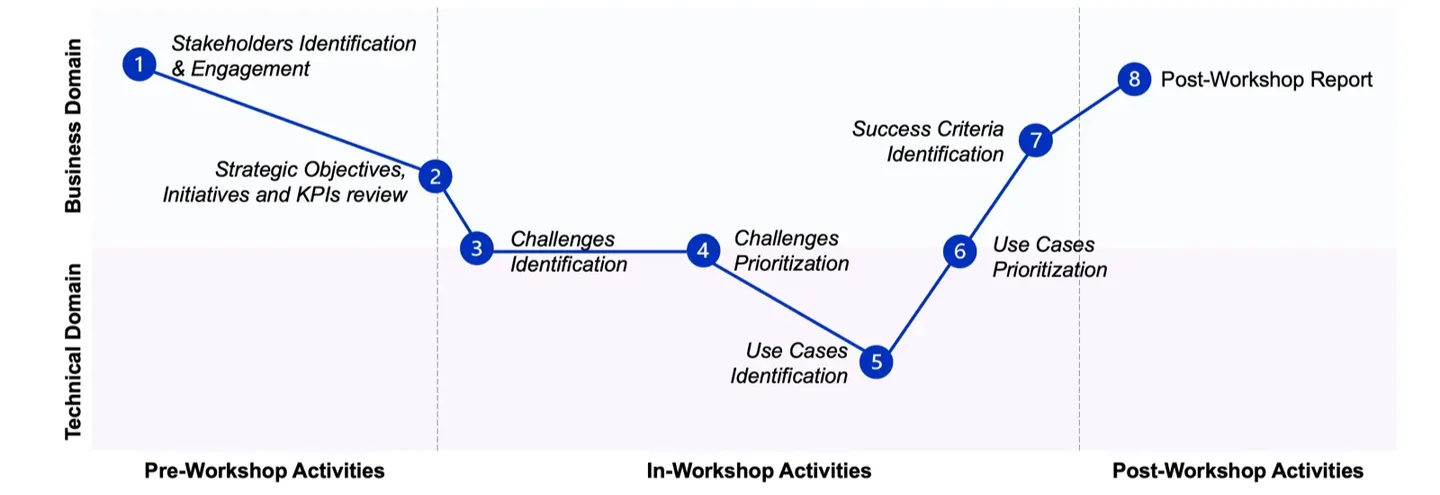
The workshop is built around eight interconnected activities delivered collaboratively by vendor and customer participants.
These activities are organised across three steps:
- Pre-Workshop Activities
- In-Workshop Activities
- Post-Workshop Activities
Each activity contributes to aligning the business and technical domains, so stakeholders can engage in a shared learning process.
This structure enables Collective Learning, producing practical outputs while strengthening internal consensus.
The chapters below provide an overview of each workshop activities.
1. Stakeholder Identification and Engagement
(Pre-Workshop | Business Domain)
Identify the right stakeholders who should attend the workshop. This ensures the customer’s decision-makers, mobilizers and influencers are well-represented.
→ Tip: Equip the sales rep with a typical participant profile to ensure broad representation.
2. Strategic Objectives, Initiatives, and KPIs Review
(Pre-Workshop + In-Workshop | Business Domain)
Capture and validate the customer’s strategic goals and key metrics. This starts before the workshop (via interviews or questionnaires) and is refined live during the workshop.
3. Challenges Identification
(In-Workshop | Business + Technical Domains)
Identify the roadblocks preventing progress toward strategic goals. The session uses guided facilitation techniques to uncover and frame the most relevant pain points.
4. Challenges Prioritization
(In-Workshop | Business + Technical Domains)
Align stakeholders on which challenges matter most. This step is essential in complex environments where priorities often vary across functions.
5. Use Case Identification
(In-Workshop | Technical Domain)
Translate top challenges into concrete solution ideas. Participants collaborate to define use cases that could effectively address the prioritized problems.
6. Use Case Prioritization
(In-Workshop | Business + Technical Domains)
Classify and sequence the proposed use cases. Quick wins are prioritized alongside longer-term strategic initiatives—helping shape a phased execution plan.
7. Success Criteria Identification
(In-Workshop | Business Domain)
Define KPIs and success metrics to evaluate the selected use cases. This ensures future implementation can be measured and tied back to business value.
8. Post-Workshop Report
(Post-Workshop | Business Domain)
Document and share a structured report covering the methodology, participants, workshop outputs, and recommended next steps. This report becomes the reference artifact for stakeholder alignment and execution planning.
The diagram below visualizes the eight activities, showing which happen before, during, and after the workshop, and how the discussion moves across business and technical domains.
Refer to Sales Enablement Artifacts for supporting materials.
Execution
To execute this Milestone, complete these activities:
- Introductory call for the Value Design Workshop
- Pre-workshop activities
- Workshop delivery
- Post-workshop activities
This Milestone is owned by the sales rep, typically in collaboration with Subject Matter Experts (SMEs) based on the workshop topic.
Successful execution also depends on active collaboration from the customer organization, both to prepare inputs and to participate in the workshop.
Detailed instructions for each activity are provided in the sections below.
1. Introductory call to the Value Design Workshop
The introductory call is a 60 minute session scheduled by the sales rep with the customer mobilizer and a small set of key stakeholders.
Its purpose is to align on why the Value Design Workshop is being run, what it will produce, and how it will be executed, including confirmation of the right participants.
During the call, the sales rep covers five topics:
- Value and purpose of the workshop
- Goals and expected outcomes
- Methodology and structure
- Proposed agenda and timeline
- Participants and logistics
This call sets expectations, creates clarity, and secures stakeholder buy in before the workshop is scheduled.
Step 1.1 Explain the value of the workshop
Start by framing why the workshop matters.
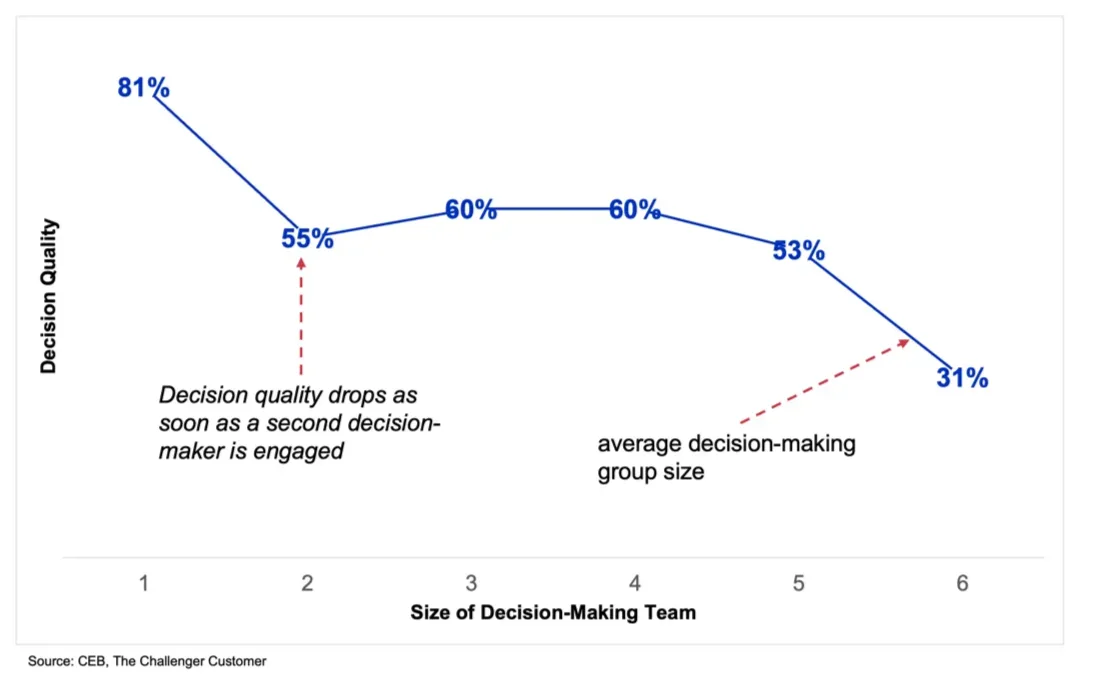
Research presented in the book The Challenger Customer shows that B2B buying decisions often involve multiple stakeholders.
As stakeholder count increases, alignment becomes harder and decisions slow down.
The Value Design Workshop is designed to reduce this complexity by bringing key stakeholders into one structured session to align on strategic objectives, priority challenges, and the path forward.
The following visual can be used to reinforce this point.
Pause here and ask:
“Does this sound valuable for the organization at this stage?”
This confirmation checks shared understanding and creates a natural transition into agreeing next steps.
If the customer does not see clear value in the workshop, stop the workshop discussion and return to Milestone 1: Value Discovery to clarify the problem, impact, urgency, and buying dynamics.
Step 1.2 Explain Workshop Goals
Next, the sales rep should explain the goals of the Value Design Workshop in practical terms. The intent is to position the session as a decision enabling step, not a theoretical exercise.
The primary goals of the workshop are:
- Identify initial use cases that can be implemented quickly to support the customer’s business objectives.
- Estimate business value for the prioritized use cases, based on customer inputs and relevant benchmarks.
- Define a preliminary implementation roadmap outlining the mid term and long term steps required to realise value at scale.
While outlining these goals, reinforce the core principle:
Creating business value at scale, and at speed, requires more than quick wins. It requires a shared direction for how value will be sustained and expanded through future initiatives. The Value Design Workshop is designed to define that direction.
This Milestone is not only about short term execution. It is about aligning the buying group on immediate priorities and future ambition, so value creation remains measurable and scalable.
After presenting the goals, ask:
- “Do these goals match what matters most at this stage?”
- “Is there any additional outcome that should be included?”
If additional goals are proposed:
- confirm whether they fit the scope of the Value Design Workshop, or
- position them as inputs for a later Milestone, if they require deeper validation, design, or decision making.
In both cases, the objective is to keep the workshop grounded in a structured process that adapts to customer priorities without losing focus.
Step 1.3 Explain Workshop Methodology
Once the customer has confirmed alignment on the goals, the sales rep explains how the Value Design Workshop will be executed.
The emphasis is not only what the workshop covers, but how it is structured to help customer stakeholders build shared understanding and reach decisions together.
Key messages to cover:
- The workshop brings the buying group together to create alignment and reduce decision friction.
- It connects both the business and technical domains so priorities, constraints, and solution implications are addressed end to end.
- The methodology is delivered through eight structured activities, distributed across three phases:
- Pre-workshop activities
- In-workshop activities
- Post-workshop activities
To support this explanation, walk through the workshop methodology diagram provided earlier. Use it to show the activity sequence and to clarify where business focus and technical focus are addressed.
Step 1.4 Explain Workshop Agenda
Present the workshop agenda using the template showed below:
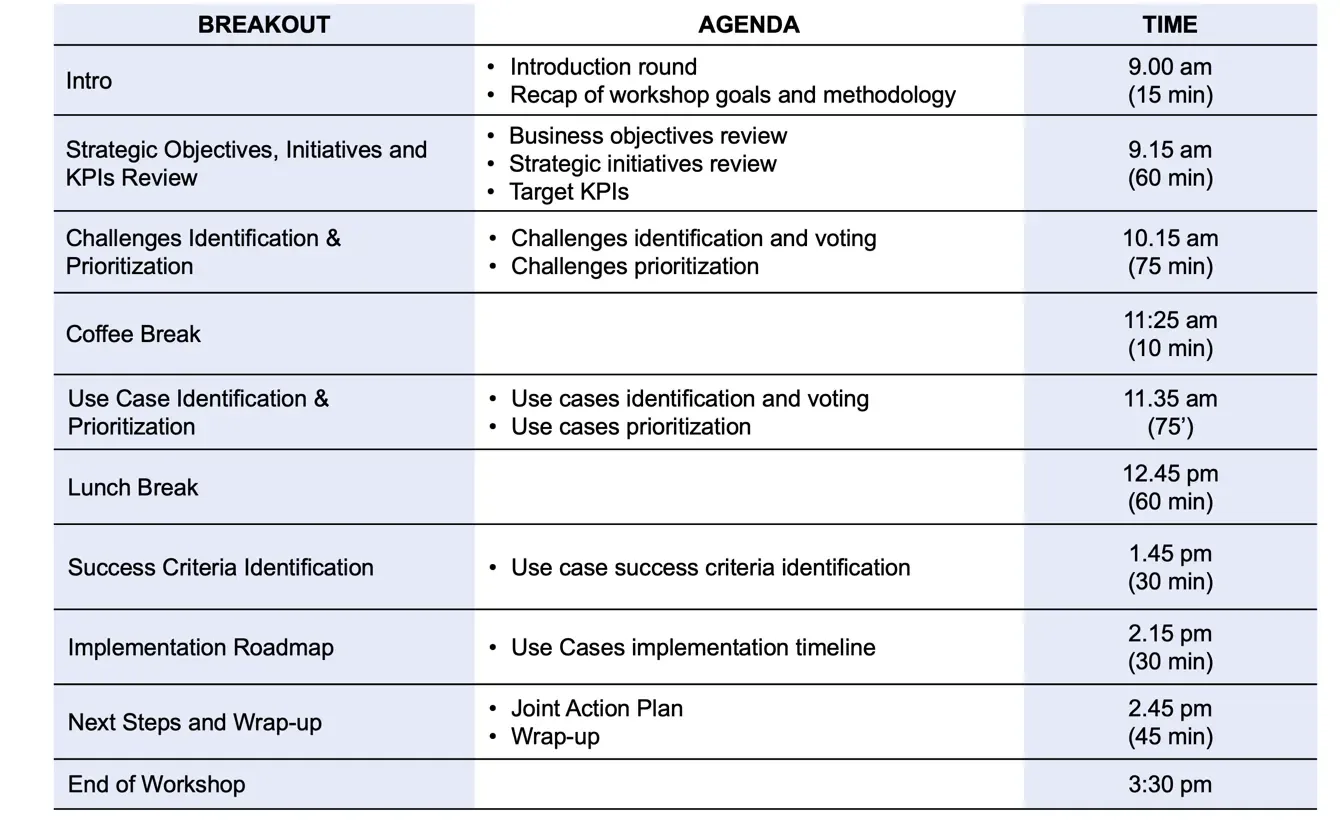
Explain the purpose and expected outcome of each session, as follows:
Intro
- Welcome, participant introductions, and a quick recap of workshop goals and methodology.
- Outcome: shared expectations and a clear working rhythm for the session.
Strategic objectives, initiatives, and KPIs review
- The customer shares business strategy, active initiatives, and key performance indicators.
- Outcome: a common reference point for what success looks like and what is already in motion.
Challenges identification and prioritization
- Participants surface the main roadblocks and align on which ones matter most.
- Outcome: a shared list of priority challenges that reflect cross-functional realities, not single-function views.
Use case identification and prioritization
- Participants translate the top priority challenges into use cases and agree on sequencing.
- Outcome: an initial use case shortlist, with clarity on what drives value and what is feasible.
Success criteria identification
- Participants define how success will be measured for the prioritized use cases and related initiatives.
- Outcome: agreed success criteria and measurable signals that can guide future decisions.
Implementation roadmap
- The group outlines a high-level timeline and the main steps required to move forward.
- Outcome: a first roadmap view that turns workshop output into a practical plan.
Next steps and wrap-up
- Review outcomes, confirm next steps, and clarify responsibilities.
- Outcome: commitment to a concrete follow-up plan and ownership across stakeholders.
Explain that this agenda is a template. It can be adapted based on current initiatives, number of stakeholders, and the focus areas that matter most.
This keeps the workshop positioned as a co-created working session, not a rigid process.
Step 1.5 Explain Workshop Timeline
Explain that full execution of the Value Design Workshop typically spans up to eight weeks, covering preparation, workshop delivery, and post-workshop follow-up.
Use the Gantt chart below to show when each activity happens before, during, and after the workshop.
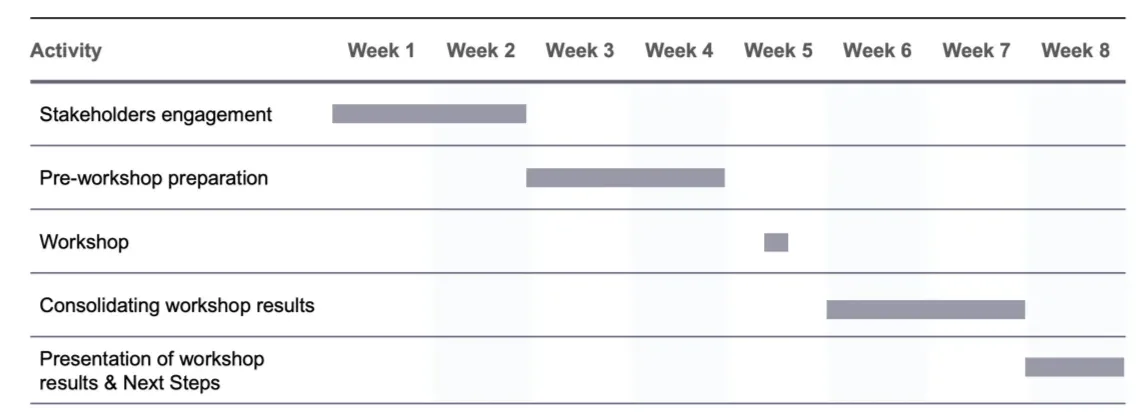
While walking through the timeline, highlight these points:
- Pre-workshop activities such as stakeholder interviews and questionnaires happen upfront and must be completed before the workshop day. They provide the input needed to tailor the session to the customer situation and stakeholder reality.
- This preparation makes the workshop more effective for both business and technical participants, since discussions start from real context instead of assumptions.
- The timeline is designed to balance structure and speed, keeping momentum without creating unnecessary load on the customer team.
Emphasize that commitment to the pre-workshop steps is foundational for success.
If the customer hesitates on the pre-workshop effort, address it directly:
- reconnect to the business outcomes that matter most
- clarify that preparation is a short investment that increases alignment quality and reduces rework later
- reinforce that without the pre-workshop input, the workshop cannot reliably deliver the intended outcome
Step 1.6 Identify Workshop Participants
For the workshop to produce meaningful outcomes, the right participants must be in the room.
Customer teams are often not fully aware of everyone who should be involved.
For this reason, proactively suggest which customer roles should be represented during the workshop.
During the introductory call:
- Present a recommended list of required customer roles for the workshop.
- Request contact details for the identified participants to arrange pre-workshop interviews or questionnaires.
- Request that participants are informed in advance that they will be contacted by the vendor team for pre-workshop activities.
After reviewing the suggested roles, confirm which individuals will represent each role and collect their contact details so that pre-workshop interviews can be scheduled accordingly.
Also share the list of vendor participants involved in the workshop.
This improves transparency and reinforces commitment through visible expertise and seniority.
To ensure productive dialogue and meaningful engagement, limit customer participation to no more than eight participants.
This group size supports alignment and encourages active contribution.
Example participant list
| Customer participants | Vendor participants |
|---|---|
| Business owner | Executive sponsor |
| Chief information officer (CIO) or Head of IT | Sales rep |
| Chief digital officer (CDO) or equivalent | Subject matter experts (SMEs) |
Notes:
- In some cases, one person can cover more than one role. This is fine, as long as all required perspectives are represented.
- Some customer roles should be present in every workshop:
- Business owner: a senior leader who can articulate business strategy, priorities, and initiatives
- Head of IT: essential when digital solutions, data, integration, or security are part of the discussion
- Other customer roles depend on the specific topic of the workshop.
- Tailor the customer and vendor participant lists to the topics in scope.
- Equip the sales rep with a library of typical participant roles to support stakeholder mapping.
- Ensure a customer and vendor senior leader are present for at least the beginning of the workshop.
Step 1.7 Explain Workshop Logistics
Confirm the practical setup early to ensure smooth delivery and active participation:
- Pre-workshop interviews: Confirm that all participants are briefed and ready to take part in a pre-workshop interview or questionnaire.
- Equipment: Participants should bring a laptop to support hands-on activities.
- Room setup: Provide a large screen or projector plus a reliable internet connection. U shape desk is preferred.
- Duration: Plan time based on the number of strategic initiatives that will be addressed during the workshop:
- Around 2.5 hours per initiative should be scheduled.
- For multiple initiatives, split the workshop across multiple days.
- Keep each workshop day within 6 hours.
- Format: Prefer in-person delivery. Use a remote setup only if in-person is not possible.
- Date and location: Agree the workshop dates and the location early to enable scheduling and preparation.
Step 1.8 Explain Market Value
Delivering the Value Design Workshop free of charge is strongly recommended, especially when the vendor does not operate a consulting business.
In that case, the focus stays on creating momentum toward the core offering, not on selling workshop days.
Even when delivered at no cost, communicate the true market value of the workshop and the related preparation and follow-up activities.
Make the positioning explicit:
- The workshop is offered at no cost to accelerate alignment and decision making.
- In a formal consulting setup, the same scope would typically be priced as a paid engagement with a meaningful fee (typically around 30k€).
- The value comes from the time investment, specialist involvement, and structured method, not from a slide deck.
2. Pre-workshop activities
Pre-workshop activities gather the inputs needed to shape a workshop that reflects the customer’s real context, priorities, and expectations.
Insights can be collected through live interviews or offline questionnaires.
Both formats work, but live interviews are preferred because they enable clarification, deeper exploration, and early relationship-building with key stakeholders.
Complete all pre-workshop activities at least two weeks before the workshop date to allow enough time for consolidation and preparation:
- Send invitations for live interviews to customer workshop participants.
- Conduct interviews with customer participants, if interviews are selected.
- Consolidate, document, and share the results of the pre-workshop activities.
This phase keeps the workshop focused and relevant, aligns expectations across stakeholders, and signals credibility through structured preparation and customer centricity.
Step 2.1 Send interview invitations
Schedule a 60 minute remote meeting with each customer workshop participant.
Use a clear subject line that signals the purpose of the meeting.
Example:
Pre-workshop interview with Mr. Robert Janson
In the invite message, briefly explain why the conversation is happening and how it supports the upcoming workshop.
Example:
Dear Mr. Janson, in preparation for the Value Design Workshop on 26th of October, an interview is planned to capture your perspective and inputs. Thank you in advance for your time. Looking forward to speaking with you.
Plan and schedule interviews early enough to allow proper consolidation and workshop preparation.
When an offline questionnaire is used instead, send it with:
- a short note explaining its purpose
- a clear submission deadline
On time completion is required to ensure high quality preparation and a workshop experience that reflects customer priorities.
Step 2.2 Conduct interviews with customer participants
When interviews are used, follow a structured approach that captures both strategic and operational insights while building rapport with key customer stakeholders.
Introduction
Open the interview by:
- Thanking the participant for their time
- Introducing yourself and the context of the engagement
- Referencing the upcoming Value Design Workshop and clarifying that the interview input will be used to tailor the workshop to the customer goals and context
- Confirming that the conversation is confidential and that there are no right or wrong answers, only honest input
- Explaining that notes will be taken and consolidated into a summary that supports workshop preparation
Keep this introduction within 5 minutes.
Then conduct the interview based on these guidelines:
Personal introduction and role context (2 to 5 min)
- Could you briefly introduce yourself and describe your role in the organization?
- How is this role connected to the strategic initiative(s) that will be discussed in the workshop?
Vision and strategic objectives (around 5 min)
- What are the overarching strategic goals or vision for the next 3 to 5 years?
- Which strategic initiatives have been defined to achieve that vision?
- Are there phases, milestones, or deadlines linked to these initiatives?
Initiatives and ownership (around 10 min)
- Which current or planned projects are you involved in that support these objectives?
- What responsibilities sit with you in driving or contributing to the initiatives?
- What support would help you be successful within this initiative?
Measuring success (around 5 min)
- How is progress toward the strategy evaluated today?
- Which KPIs or success criteria are used, or should be used, to track progress?
- Are there targets or thresholds for these KPIs?
Challenges and bottlenecks (around 10 min)
- What are the biggest challenges being faced, or expected, in executing the strategy?
- Why do these challenges exist?
- Which challenges feel most urgent or most impactful?
- What has already been tried to address them, and what worked or did not work?
Scaling success and unlocking value (around 5 min)
- What would be needed to scale a successful pilot across the wider organization?
- Which resources, technologies, competencies, or partners are required to reach the goals at scale?
Expectations for the workshop (around 5 min)
- What outcomes are expected from the Value Design Workshop?
- Which questions or concerns should be addressed during the session?
Additional input (around 3 min)
- What important input has not been covered that should be considered in workshop preparation?
Optional for technical roles: technical infrastructure (5 to 10 min)
- Which systems, platforms, or assets are already in place that could support the initiative?
- Which data sources are currently available that could be used to measure or improve performance?
- Are there known integration or interoperability constraints across systems or departments?
Step 2.3 Consolidate, document, and share the interviews results
After completing all interviews or collecting the questionnaire responses, consolidate the input into a structured pre-workshop report and share it with all workshop participants.
This report serves three purposes:
- Customize the workshop by shaping the agenda, focus areas, and facilitation approach.
- Align the vendor team by creating one shared view of the customer context.
- Create a shared baseline so the workshop starts with focus and clarity, not repeated explanations.
Summarize patterns across stakeholders while capturing relevant stakeholder-specific nuances. Ensure the report reflects:
- the strategic objectives and initiatives mentioned by participants
- the recurring challenges and blockers raised
- misalignments or conflicting views that require clarification during the workshop
- the perceived maturity of the customer organization on the topic of interest
- additional themes that emerged and may merit workshop time
Where helpful, cluster recurring themes and indicate priority based on frequency, impact, or stakeholder emphasis.
Use the collected insights to assess maturity on the workshop topic:
- High maturity: focus the workshop on pressure-testing assumptions, deepening the challenge and value discussion, and co-defining how the proposed approach accelerates initiatives and measurable outcomes.
- Low maturity: increase facilitation and structure. Focus first on clarifying objectives, aligning language across stakeholders, and creating a baseline roadmap before going deeper into solution detail.
Prepare a workshop facilitation tool based on the interviews results:
- pre-populate objectives, initiatives, and KPIs
- capture challenges and blockers to validate and prioritize in the workshop
- adding early use case hypotheses or solution ideas when the customer input is clear enough
Note:
- A dedicated digital tool purposely designed by the Value Accelerator team is available to facilitate the Value Design Workshop. Reach out to the Value Accelerator team to learn more.
3. Workshop Delivery
The sections below provide guidance on how to conduct each part of the workshop effectively.
Step 3.1 Introduction
Open the session with a welcome and a short round of introductions.
Then recap the workshop goals, methodology, and agenda using the same material shared in the introductory call.
Re-establishing shared context at the start keeps the session focused and reduces drift later.
Before moving into the first activity, set clear participation principles to create a collaborative atmosphere:
- No formalities, no grades: open discussion matters more than polished answers.
- Speak up: active contribution from everyone strengthens the output.
- Feel free to move: standing, stretching, or walking around is encouraged.
- Ask for breaks: breaks can be taken whenever needed.
- Bring a laptop: laptops are required for the hands-on activities.
This introduction typically takes around 15 minutes.
Step 3.2 Strategic Objectives, Initiatives, and KPIs Review
In this session, the customer business owner presents the strategic context for the topic addressed in the workshop, including:
- Business outcomes and objectives: the specific, measurable results the customer organization aims to achieve for the initiative in scope.
- Strategic initiatives: the programs, projects, or actions planned or already underway to achieve those outcomes.
- Key performance indicators (KPIs): the metrics used to measure progress and success, including target values and timelines.
Example:
- If the workshop focuses on sustainability, a business outcome could be: “Achieve full sustainability of manufacturing operations within five years.”
- A related strategic initiative could be: “Adopt green energy sources,” with a KPI such as “tons of carbon emissions reduction,” and a target like “20,000 tons of CO₂ equivalent reduced per manufacturing site over five years.”
Before the workshop, prepare a digital tool or application to support collaborative work.
The tool should be pre-populated with the inputs gathered during the pre-workshop phase:
- business outcomes
- strategic initiatives
- target KPIs
- challenges linked to each initiative
During the session, update the tool live as stakeholders add details and corrections.
Keeping a shared view visible throughout the discussion creates transparency and reduces misunderstandings.
Below is a screenshot of a digital tool purposely designed by the Value Accelerator team to facilitate the workshop.
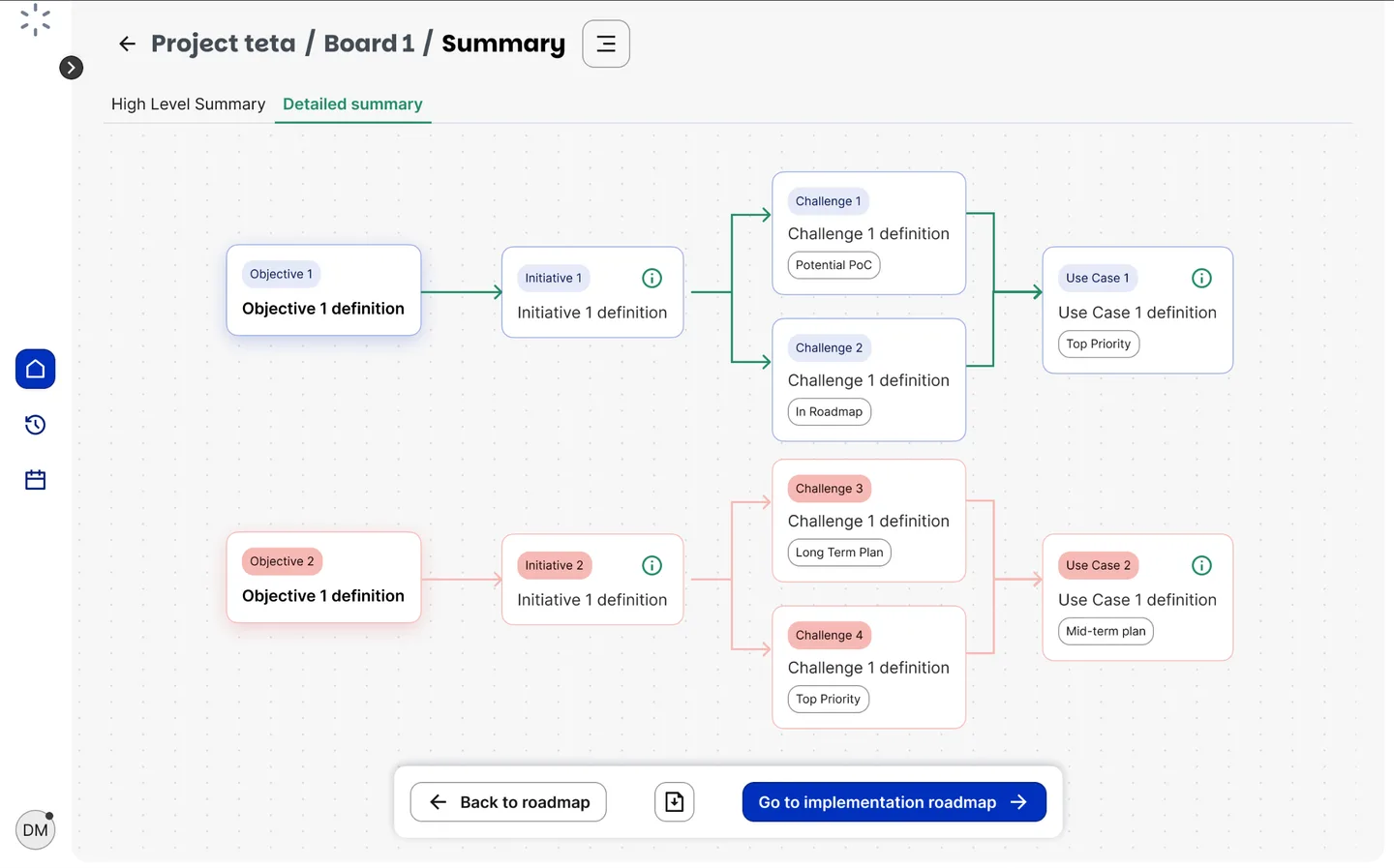
During the discussion:
- Update the digital tool with new or refined information, keeping it visible to all participants.
- Facilitate the conversation with open questions and active listening. These inputs will later be used to connect challenges and use cases back to strategic objectives.
- Validate the captured content by asking the business owner to review and confirm what has been documented.
In the image below, a screenshot of the Value Accelerator app used to capture the workshop discussion around business objectives, strategic initiatives, and KPIs.
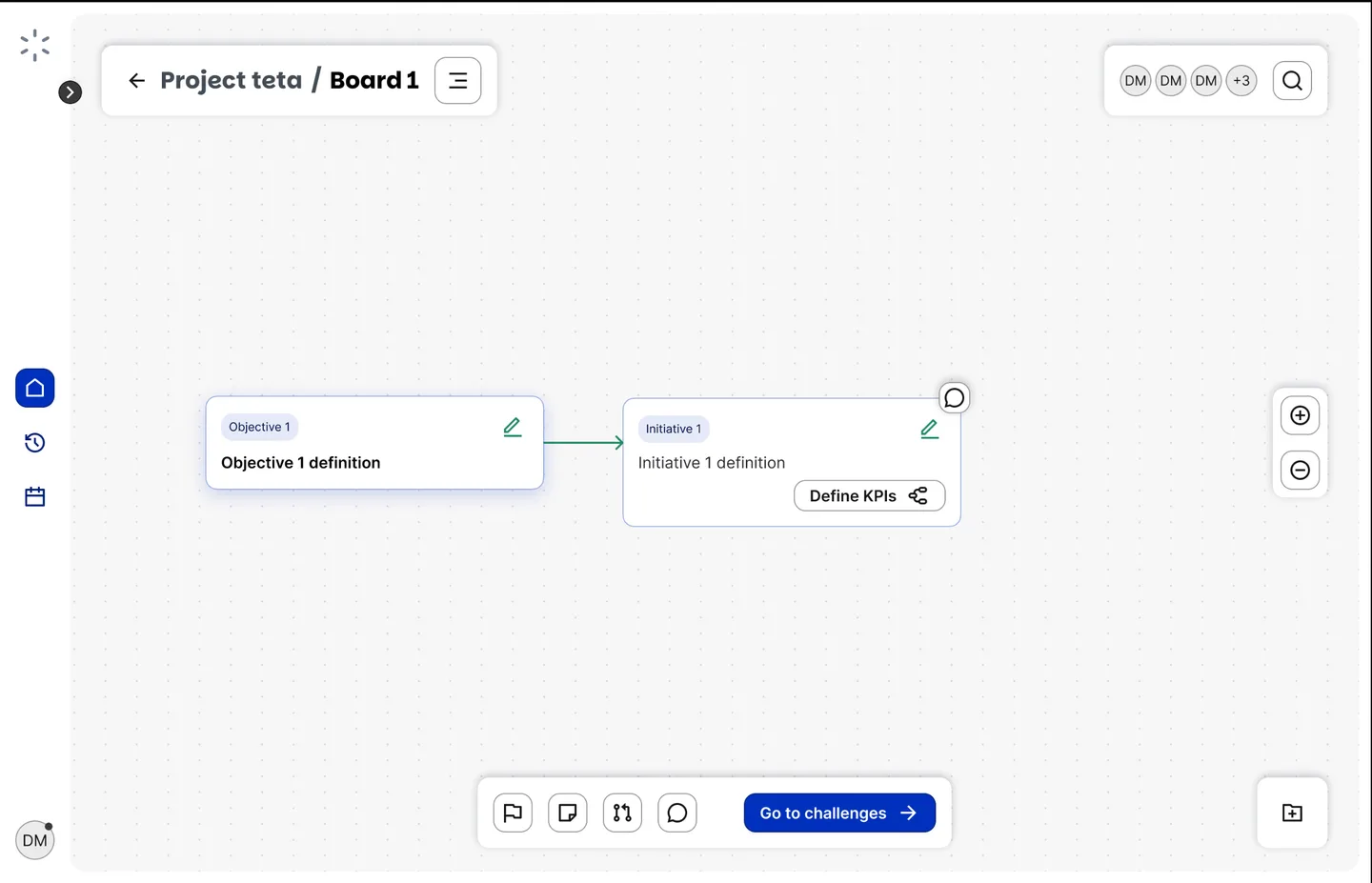
This session lasts around 60 minutes and establishes a shared baseline on goals and priorities and sets the foundation for the rest of the workshop.
Step 3.3 Challenges Identification and Prioritization
This session identifies and prioritizes the challenges that prevent successful execution of the customer’s strategic initiatives.
Repeat the activity for each strategic initiative captured earlier in the workshop.
Facilitate the exercise using a digital tool purposely designed to facilitate the workshop.
Allocate around 70 minutes to challenges identification and prioritization.
The sections below provide detailed guidance for running the challenges identification and prioritization activities using the digital tool.
3.3.1 Log in to the digital tool
Start by inviting all customer participants to log in to the digital tool that the vendor is using to facilitate the workshop.
Keep the flow simple:
- Confirm everyone can access the tool before moving on.
- Expect minor login issues for a few participants and resolve them quickly.
- Log in as facilitator and share the screen on a large monitor or projector so the group can follow the activity.
Once everyone is connected, invite participants to create their avatar by entering their name and role.
The image below shows an example section of the Value Accelerator app where participants can set up their avatars:
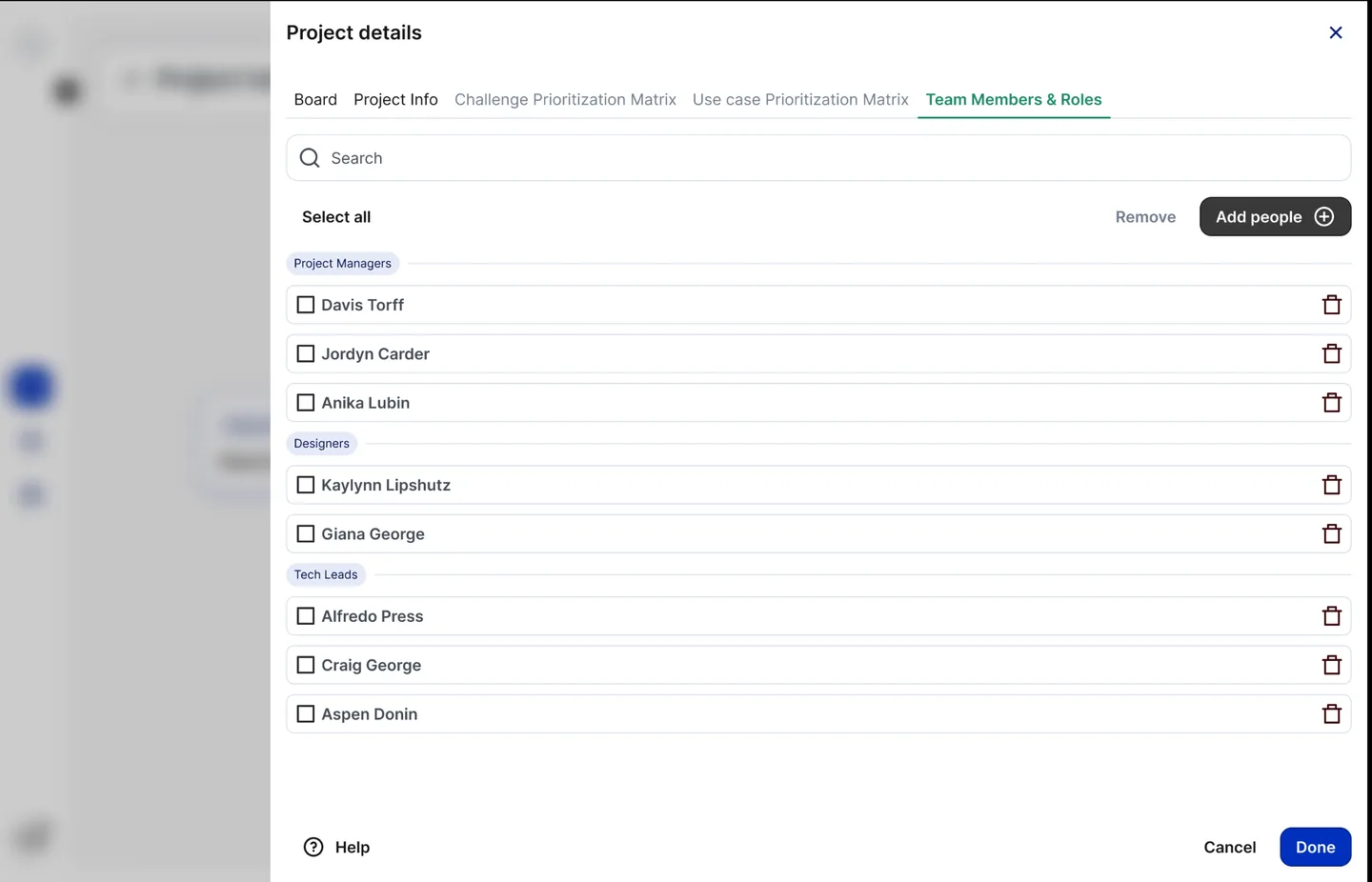
Use this moment to set the tone for participation:
- Encourage patience and support for anyone unfamiliar with the tool.
- Reinforce that input is exploratory and that every perspective matters.
Estimated time: 5 minut****es.
3.3.2 Challenges Identification
Once all customer participants are logged into the digital tool, explain how the challenges activity will run for each strategic initiative.
For each strategic initiative, the tool provides a pre-populated list of challenges commonly associated with that type of initiative. These inputs are taken from prior engagements with similar customers and provide a practical starting point.
Invite participants to:
- review the pre-populated list and familiarise themselves with the proposed challenges
- add new challenges directly in the tool when something is missing
Rules:
- there are no limits to the number of new challenges that can be created
- newly added challenges become visible to everyone and can be reviewed by others
Optionally, run a short open discussion to clarify meaning and remove ambiguity before voting starts. This helps ensure that everyone is interpreting the challenges in the same way.
Clarify why the activity starts with a pre-curated list:
- it brings patterns and lessons learned from past customer engagements, which helps the group move faster, especially when it is not yet clear where to begin
Estimated time: 10 to 15 minutes.
3.3.3 Challenges Voting
Once the full list of challenges is in place, move to voting.
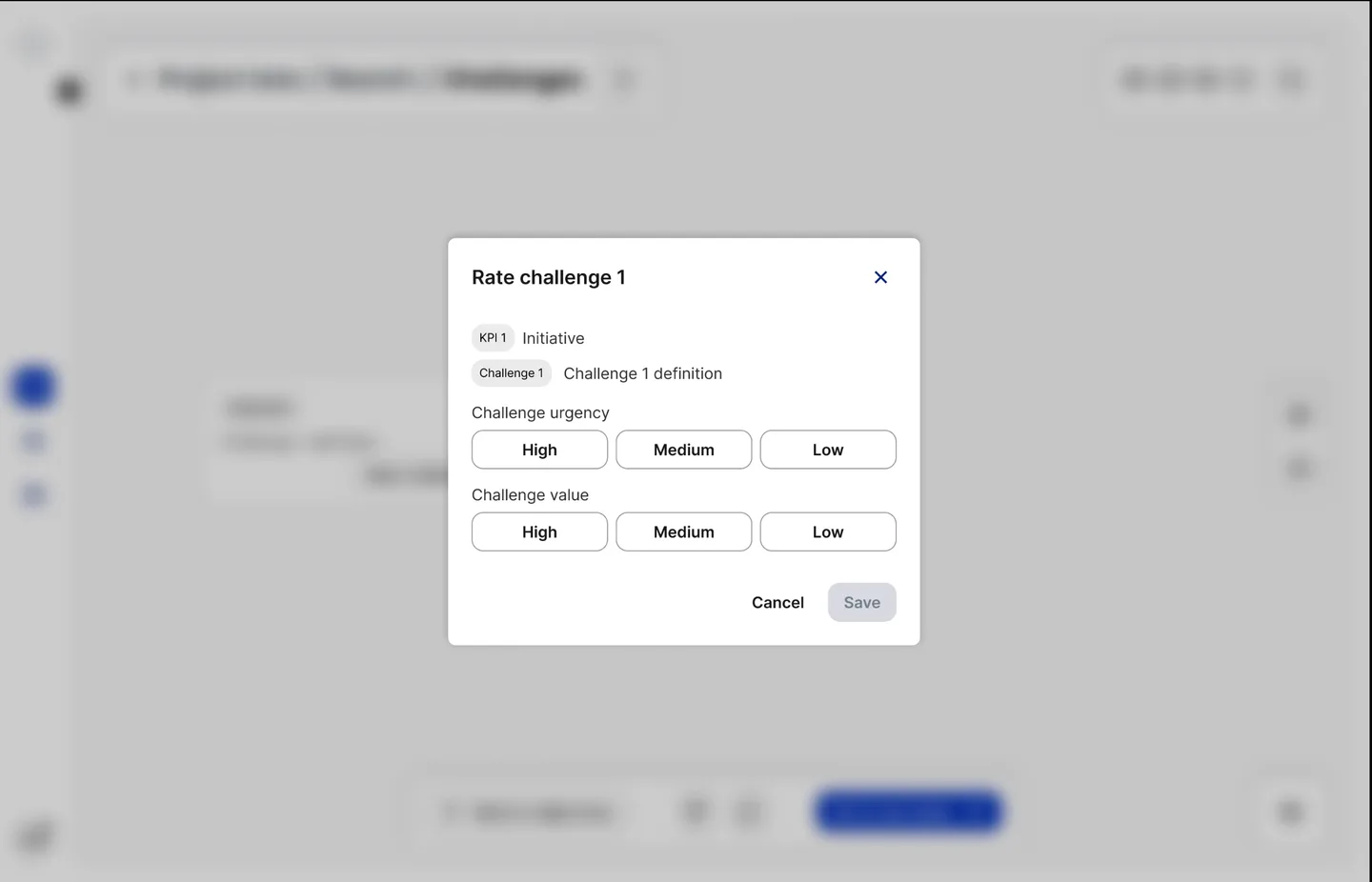
Ask participants to vote on the challenges that are relevant, using two dimensions:
- Urgency: how soon the challenge needs to be solved
- Challenge value: the impact of solving it, or the consequence of not solving it
Voting rules:
- vote on as many challenges as needed
- each challenge can be voted on only once per participant
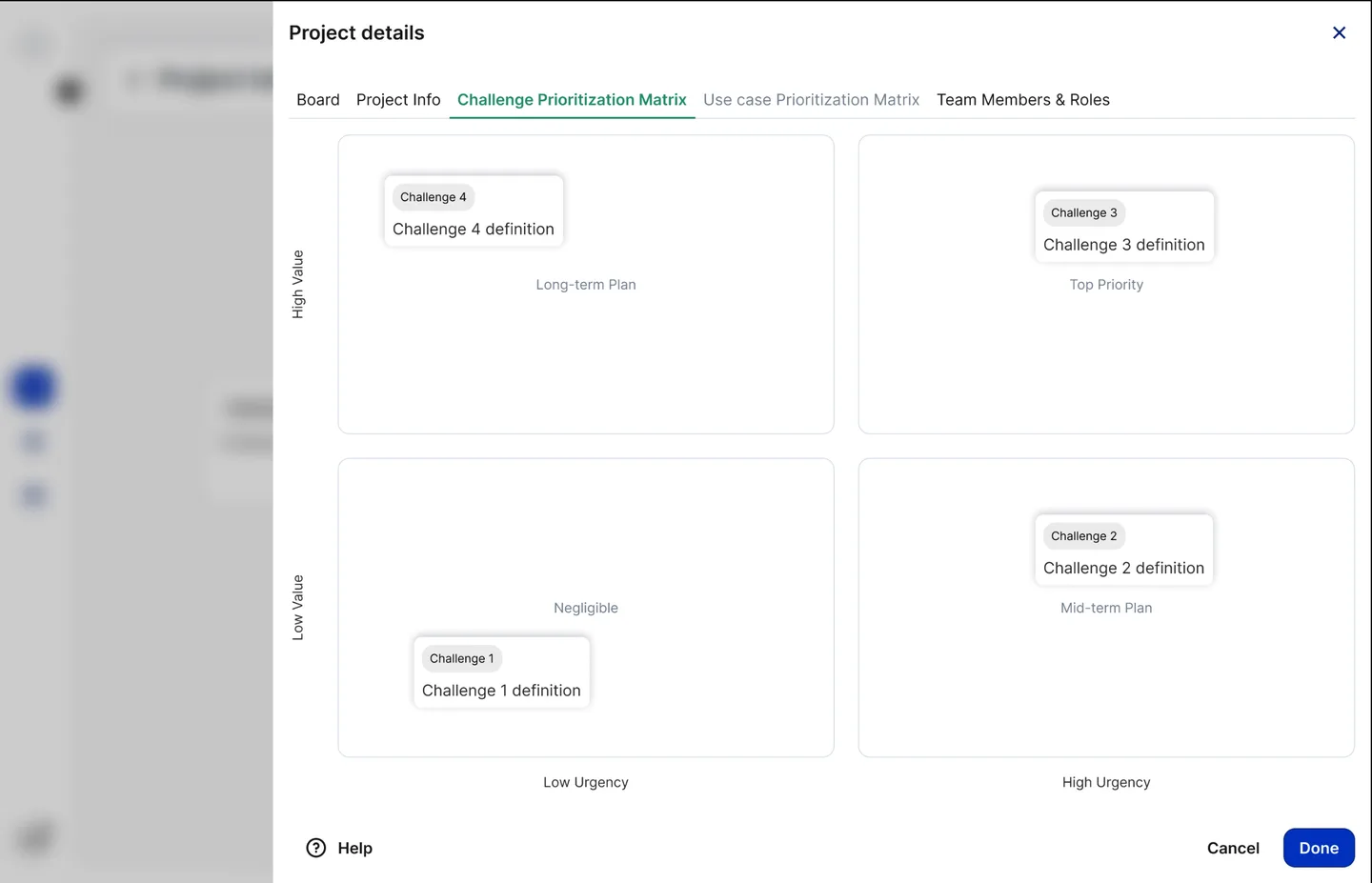
As voting happens, the digital tool automatically updates the challenges prioritization matrix in real time.
Keep the shared screen visible so everyone can follow progress as the matrix populates.
During the activity:
- help quickly if someone struggles with navigation or voting
- manage time and prompt the group if progress slows
Estimated time: 30 minutes.
The screenshot below shows the challenges voting screen from the Value Accelerator app.
3.3.4 Open Discussion
Once voting is complete, use the challenges prioritization matrix as the basis for discussion.
The matrix offers four quadrants to guide the discussion:
- Low urgency | low value: negligible
- Low urgency | high value: long-term plan
- High urgency | low value: mid-term plan
- High urgency | high value: top priority
This shifts the conversation from individual opinions to a shared view of priorities.
Start with a quick review of what the matrix shows:
- which challenges sit in top priority (high urgency, high value)
- which challenges appear as mid-term plan, long-term plan, or negligible
- where votes are dispersed, indicating potential misalignment across functions
To increase participation and surface hidden perspectives, begin with the challenges that land outside the obvious top priorities, or those where voting is inconsistent.
Example prompt:
“Let’s review the matrix. A few challenges are clearly top priority. I also notice that ‘xxx’ sits high on value but low on urgency, and ‘yyy’ has mixed votes across the group. What is driving those differences in perspective?”
Use the discussion to:
- validate overlooked pain points
- clarify whether a challenge is role-specific or broader than it first appears
- confirm whether any challenge should be reframed or split into separate challenges
- align on which challenges will move forward into use-case definition
When challenges outside the vendor scope appear, acknowledge them, capture them, and then steer the dialogue toward the challenges where tangible support and solutions can be provided.
Estimated time: 20 minutes.
Step 3.4 Use Cases Identification and Prioritization
This is the second core activity of the workshop. It uses the same structured approach as the challenges exercise, but shifts the focus from problems to solutions.
In this session, customer participants identify and prioritize the solutions to the top challenges. These solutions are referred to as “use cases”.
Each use case represents a specific set of capabilities that the customer organization can leverage to address one or more of the prioritized challenges.
The objective is to co-create a set of relevant, feasible, and high-impact use cases that can deliver measurable value.
This session should last approximately 75 minutes.
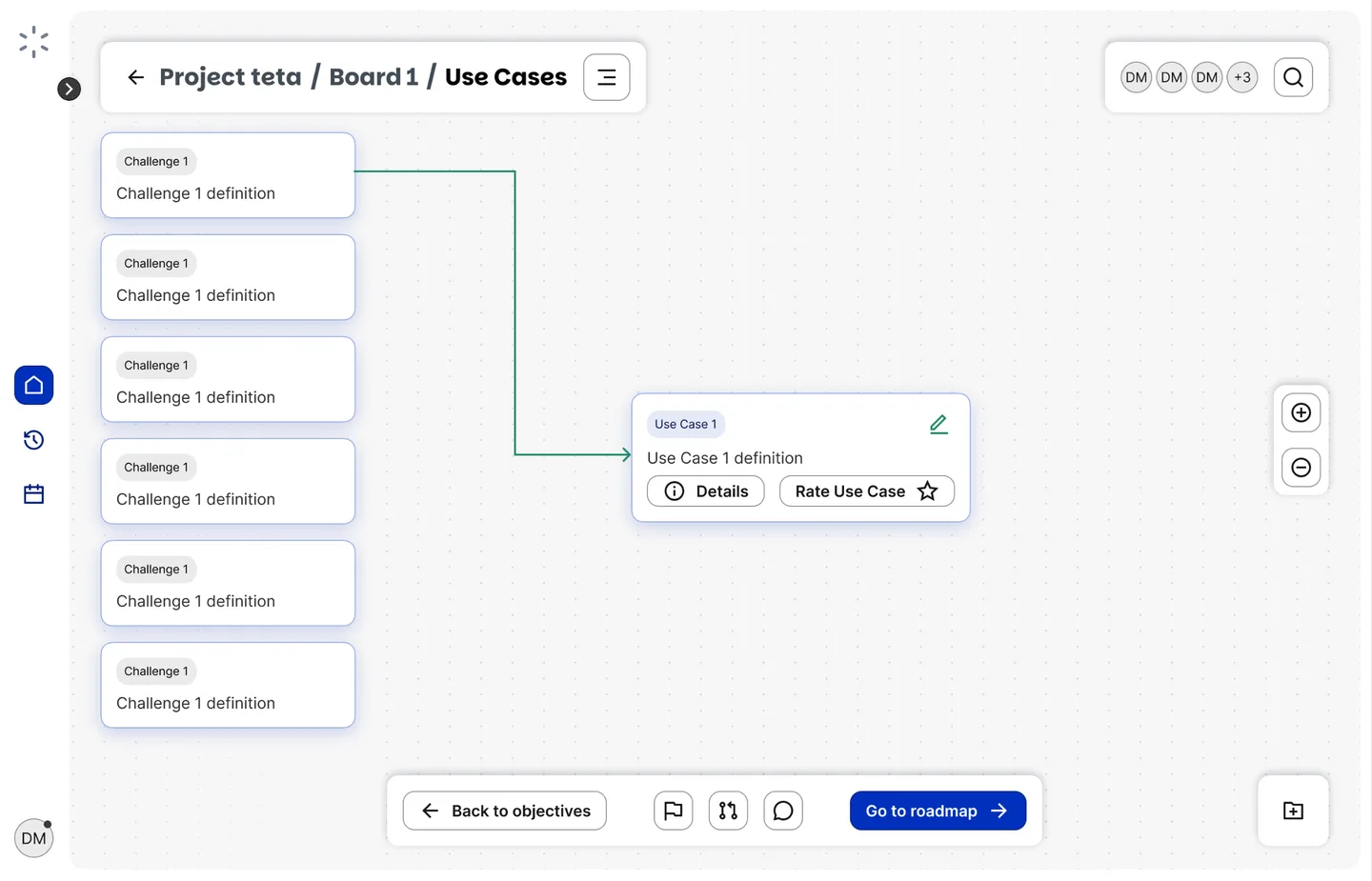
3.4.1 Use Cases Identification
Start by identifying all relevant use cases for the top-priority challenges.
A pre-populated list of use cases should be available as a starting point. These inputs reflect experience from similar customer engagements and help the group move faster.
Invite participants to:
- familiarise themselves with the proposed use cases
- add new use cases directly in the tool when something is missing
Rules:
- there are no limits to the new use cases participants can create
- newly added use cases become visible to everyone and can be reviewed by others
Use a short open discussion to clarify what each use case means, remove duplicates, and align on wording before voting starts.
When helpful, show quick demos or tangible samples to make the use cases concrete. Short walkthroughs, screenshots, mockups, or lightweight prototypes reduce ambiguity and improve the quality of the prioritization discussion.
Notes:
- Maintain a challenges-to-use-cases map that links common challenges to suitable use cases.
- Keep the map evolving based on lessons learned across industries, projects, and delivery experience.
- When possible, integrate the map into the digital tool so use cases are suggested automatically once key challenges are selected.
- If the digital tool does not support automatic suggestions, schedule a 10-minute break after completing challenges prioritization.
- Use the break to populate the tool with a curated list of use cases aligned to the customer’s top-priority challenges.
This approach matters because it:
- reduces the risk of selecting use cases that are irrelevant or low impact
- avoids use cases that sit outside the vendor delivery capability or product scope
- anchors the discussion in proven experience while staying driven by customer-defined priorities
Typical duration: 45 minutes.
3.4.2 Use Cases Voting
Once the full use case list is captured and clarified, move into voting.
Invite participants to vote for the use cases considered relevant and impactful.
Rules:
- each participant can vote on as many use cases as needed
- each use case can be voted on only once per participant
Ask participants to vote using two dimensions:
- Value: what business impact is expected if the use case is implemented
- Complexity: how difficult implementation is likely to be, considering feasibility, dependencies, resources, and change effort
As voting happens, the digital tool should automatically populate the use case prioritization matrix in real time with the results.
Keep the shared screen visible so progress is transparent.
Vendor support is especially important when evaluating complexity.
Value is often easier for customer participants to estimate, while complexity may be underestimated. For digital initiatives, complexity often comes from integration requirements, data readiness, security constraints, and third-party dependencies.
During voting:
- help quickly if someone struggles with navigation or voting
- offer clarification when feasibility or delivery effort is unclear, especially on complexity
- manage time and prompt the group if progress slows
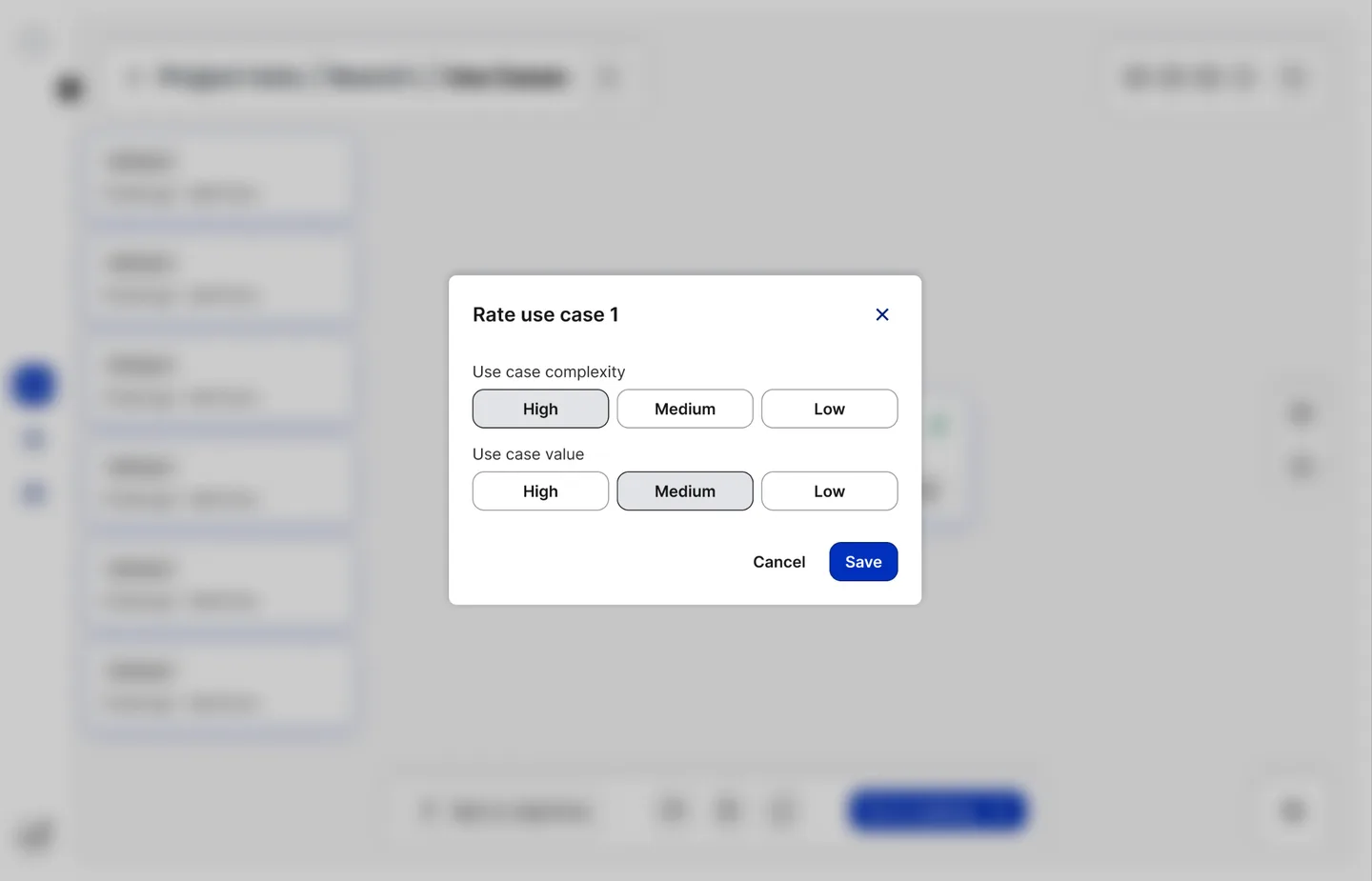
Estimated time for voting: 15 minutes
3.4.3 Open Discussion
Once voting is complete, use the use case prioritization matrix as the basis for an open discussion.
The matrix offers four quadrants to guide the discussion:
- Low value | low complexity: potential PoC
- Low value | high complexity: negligible
- High value | high complexity: in roadmap
- High value | low complexity: top priority
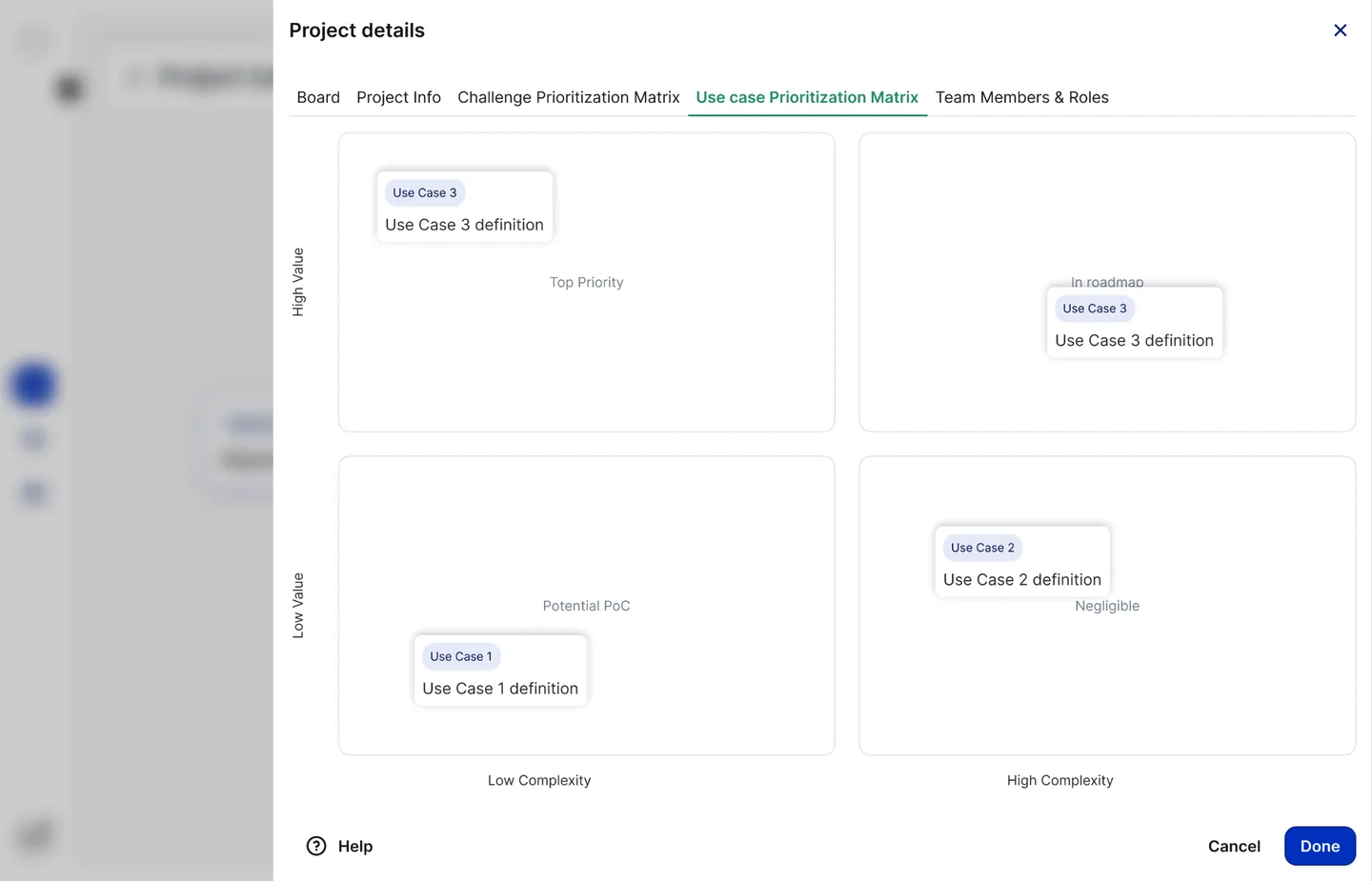
Start with a quick review of what landed in each quadrant. Use the discussion to:
- validate why certain use cases score high on value
- pressure-test complexity assumptions, especially for highly voted use cases
- clarify which use cases are quick wins versus longer-term initiatives
- capture role-specific needs that may not be visible from votes alone
Treat this as an alignment activity, not a passive review of results.
Where useful, invite input from participants who voted strongly for use cases that others did not prioritize. This often surfaces context that improves shared understanding.
Actively contribute vendor perspective, especially on complexity, and add practical benchmarks from similar projects to keep the discussion realistic.
Close by confirming the shortlist of prioritized use cases and the rationale behind them.
Typical duration: 15 minutes.
Step 3.5 Success Criteria Identification
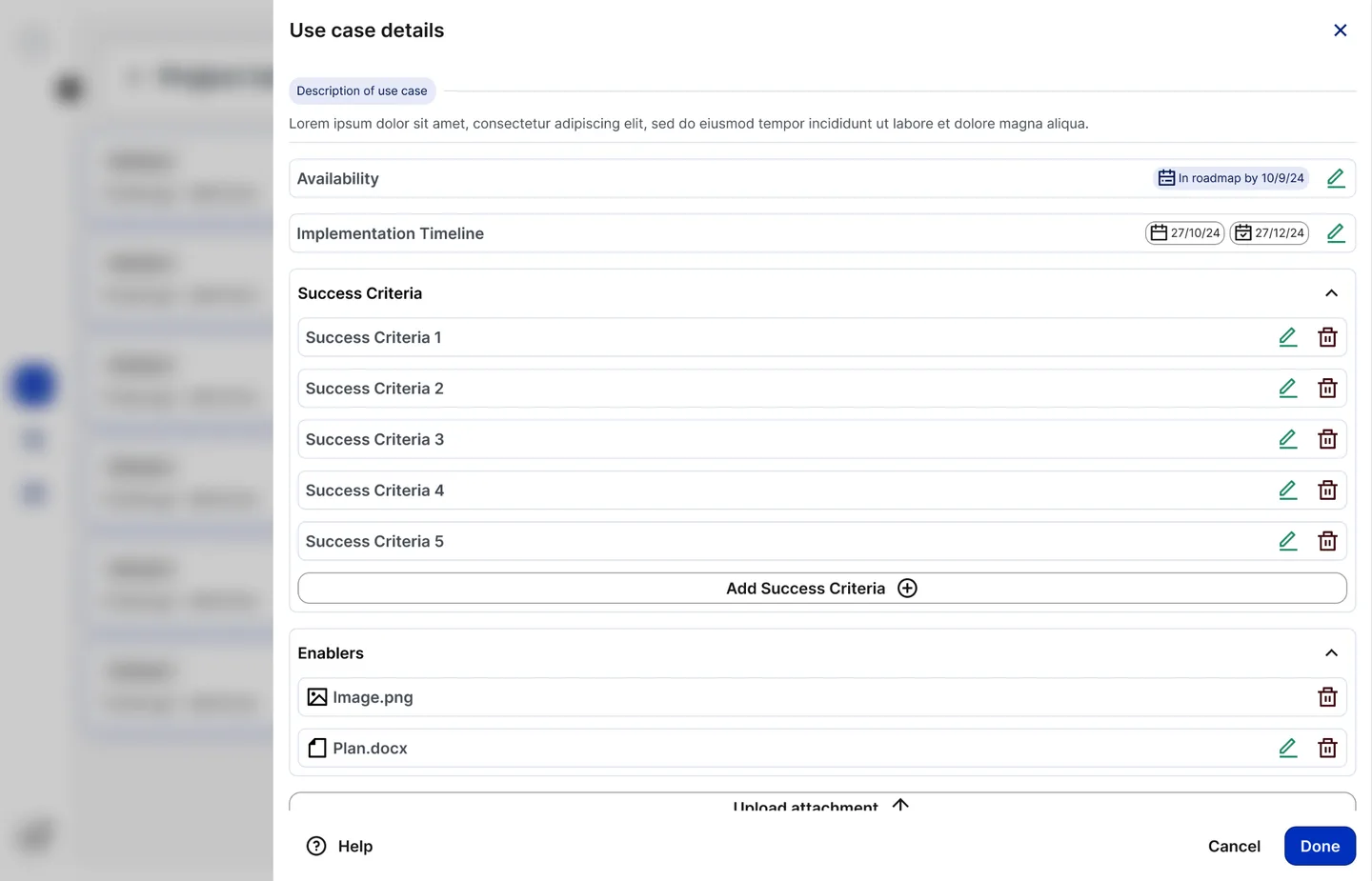
This session defines the success criteria used to confirm whether the top-priority use cases deliver measurable value.
Success criteria should be:
- Specific: focused on concrete outcomes
- Measurable: clearly verifiable
- Relevant: directly tied to the use case, the related challenge and business objectives
Success criteria typically fall into three categories:
- Successful delivery of a use case
- Technical capabilities of the solution
- User experience and adoption
Open the session by clarifying what success criteria are and how they guide next decision points.
Run an open discussion to define success criteria for each top-priority use case.
Use the digital tool to accelerate the discussion by offering typical success criteria templates for each use case.
Customer ownership is essential. Success criteria should not be imposed by the vendor.
When defining criteria feels difficult, introduce practical examples and steer toward outcome-based measures.
When a proposed criterion is too vague or not applicable, explain the gap and guide the group toward more meaningful alternatives.
For each use case, aim for one to three clear, measurable success criteria.
Capture the agreed success criteria in the digital tool.
The image below shows how success criteria can be added in the Value Accelerator digital tool for each selected use case.
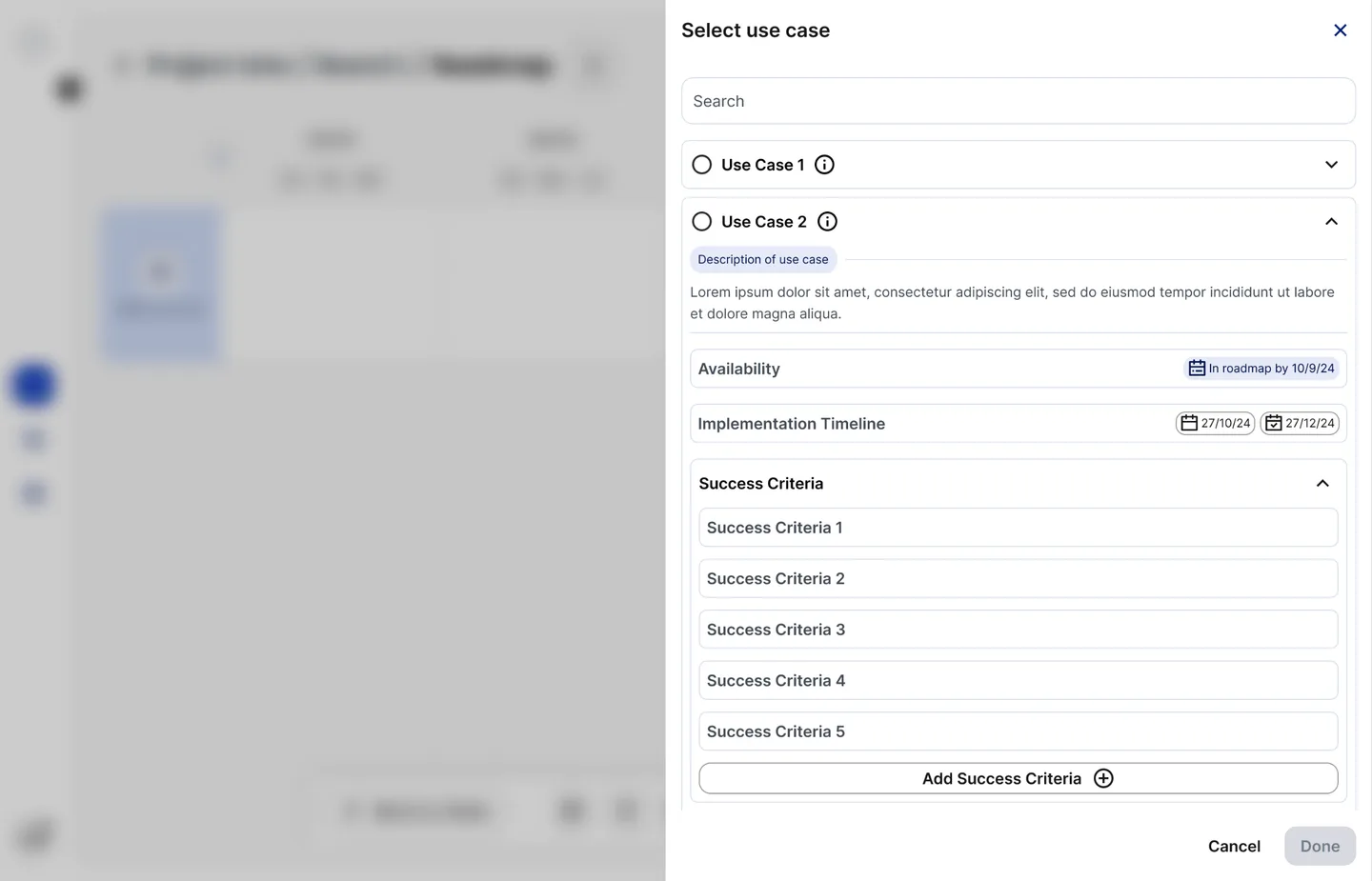
Before closing the session, link each prioritized use case and its success criteria back to the KPIs of the customer strategic initiatives discussed earlier in the workshop.
This step positions the use cases as drivers of measurable progress on strategic priorities, not isolated tactical activities. It also strengthens executive alignment by showing how the workshop outputs support broader transformation goals.
The image below shows how strategic objectives, initiatives, challenges, and use cases are linked in the Value Accelerator app.
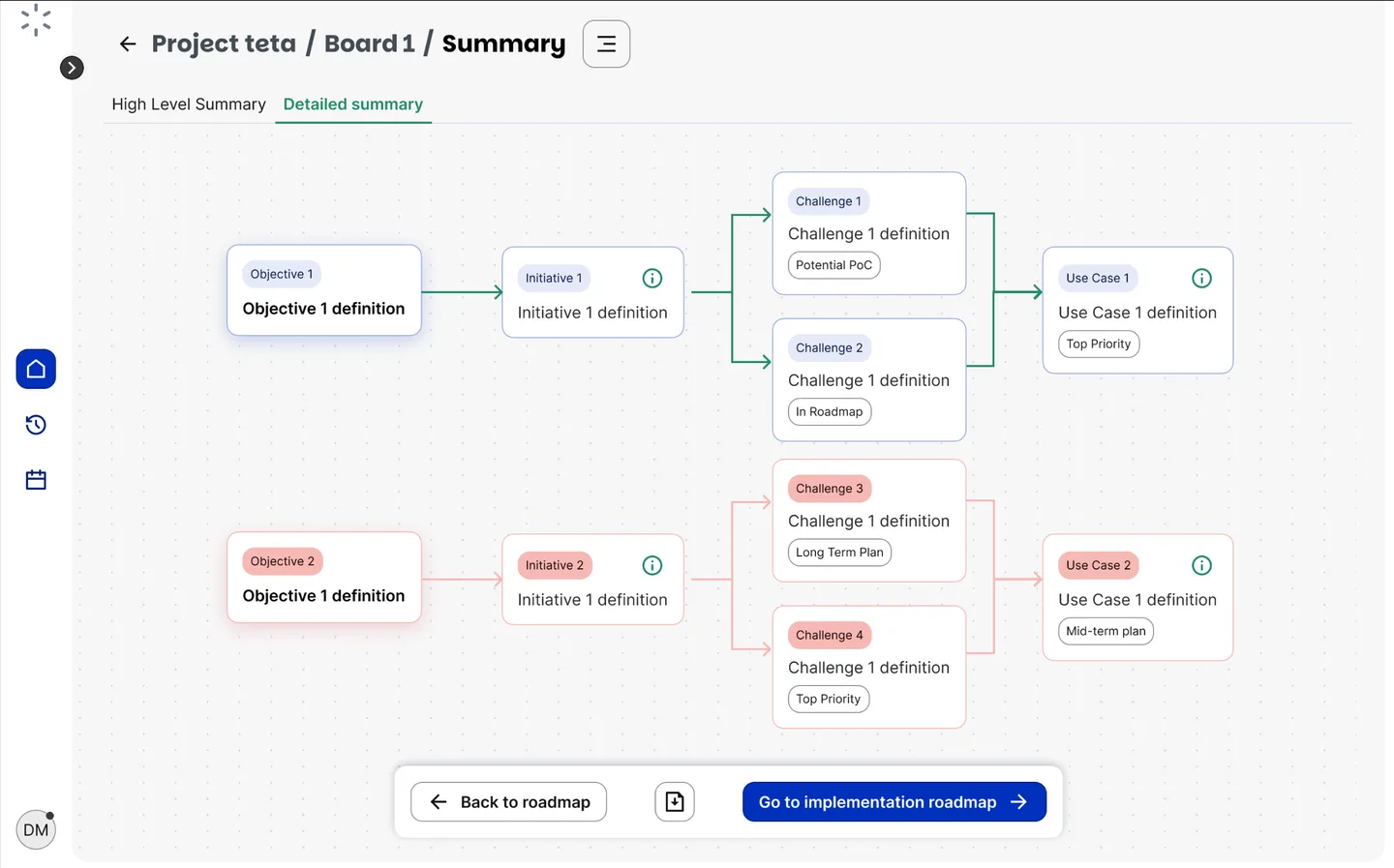
Typical duration: 30 minutes.
Step 3.6 Implementation Roadmap
This session builds alignment on a realistic implementation timeline for the prioritized use cases.
Use the use case prioritization matrix as the starting point, then translate priorities into a phased roadmap.
Start by reviewing the use cases in the “top priority” quadrant of the use case prioritization matrix.
Confirm whether the buying group agrees to start implementation with these use cases.
Once alignment is reached, bring in vendor SMEs to assess execution sequencing:
- confirm whether the top-priority use cases can run in parallel, or whether dependencies require a staggered approach
- if sequencing is required, recommend an execution order based on effort, prerequisites, and value delivery logic
Then shift to the use cases in the “in roadmap” quadrant.
These use cases combine high value with higher complexity.
Use vendor SME input and customer constraints to place them into a mid- to long-term horizon, including indicative timing and prerequisite milestones.
Close by reviewing the “potential PoC” quadrant.
These are low-complexity, low-value use cases that can support enablement, confidence building, or capability demonstration.
Where relevant, include a small subset in the roadmap, or keep them as optional items.
Capture the roadmap in the digital tool so the timeline remains visible and aligned in real time.
The image below shows an example of a roadmap created in the Value Accelerator app.
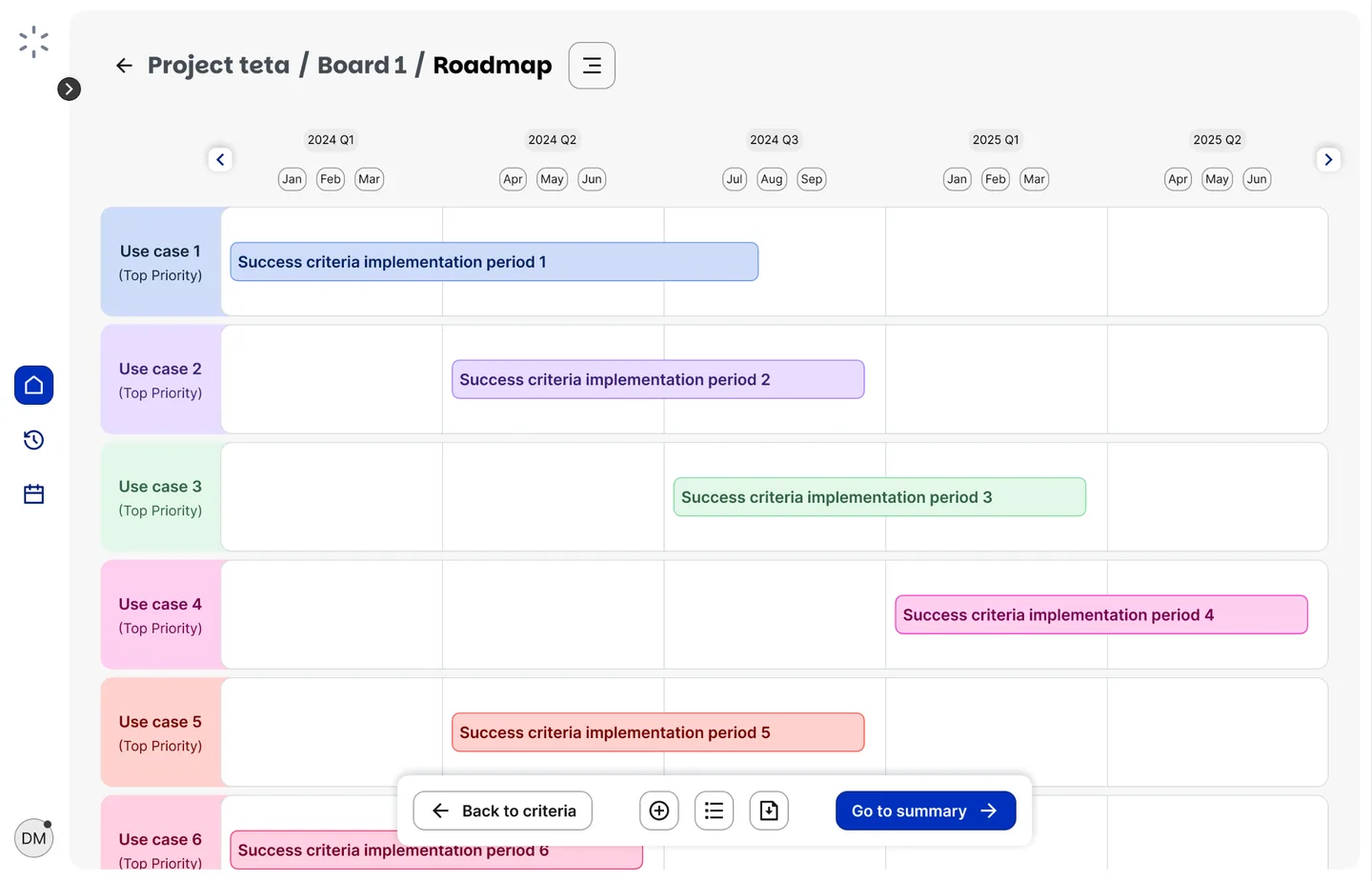
If feasibility questions emerge, clarify that the roadmap is preliminary.
Technical readiness, resourcing, and timeline constraints will be validated after the workshop via a dedicated feasibility assessment.
Typical duration: 30 minutes.
Step 3.7 Next Steps and Wrap-Up
3.7.1 Joint Action Plan
This session defines a clear, actionable path forward and confirms how progress will continue after the workshop.
Use the Milestones of the Value Accelerator GTM Blueprint as a structuring lens for the next phase of the engagement.
This keeps the action plan tied to the customer strategic priorities while remaining consistent with a structured customer engagement process.
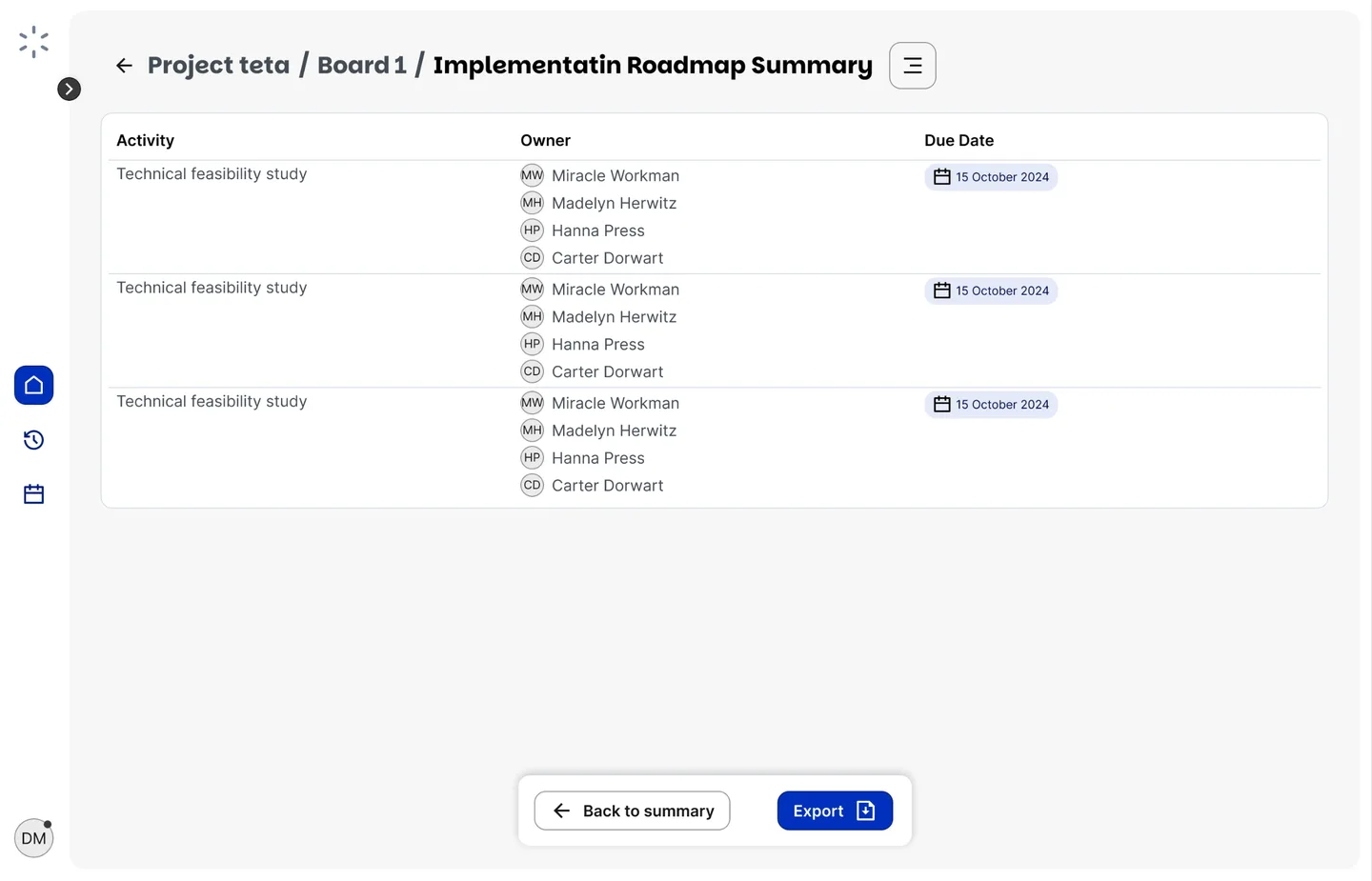
Capture all action items directly in the digital tool.
Typical examples of follow-up actions include:
- scheduling a technical deep dive on selected use cases
- sharing additional documentation
- initiating a feasibility assessment
- preparing the final workshop summary report
For each action item, confirm two elements:
- assign one accountable owner on either the customer or vendor side
- agree a due date to enable follow-up and progress tracking
Documenting actions in real time keeps visibility high and reduces post-workshop ambiguity.
Before closing the session, confirm explicit agreement on the action plan and confidence in the next steps.
The image below shows an example of how next steps can be captured in the Value Accelerator app.
Typical duration: 30 minutes.
3.7.2 Wrap-Up
This is the final activity of the workshop.
The purpose is to consolidate outcomes, capture reflections, and close with shared clarity.
Start by summarising the workshop outputs and linking them back to the customer’s broader direction:
- prioritized use cases
- success criteria
- implementation roadmap
- connection to the customer business objectives, strategic initiatives, and KPIs
Then invite short reflections from each participant to reinforce ownership and collect immediate feedback.
Use a small set of open questions, for example:
- did the workshop achieve the goals?
- were expectations met?
- what worked well?
- what should be improved next time?
Listen actively, ask clarifying questions where needed, and capture feedback in the tool.
Once the wrap-up is complete, lock the digital tool and keep it available in read-only mode. This preserves transparency while protecting the integrity of the documented outcomes.
Typical duration: 15 minutes.
4. Post-workshop Activities
Once the workshop is complete, run a short internal debrief with the vendor participants who attended.
Use this meeting to align on key outcomes, clarify open points, and start execution of the agreed action plan.
When the action plan was captured cleanly during the workshop, it should connect naturally to the next Milestones of the Value Accelerator GTM Blueprint.
A typical priority after the workshop is the creation and delivery of the workshop report.
The sections below provide guidance on how to consolidate outcomes and complete the handover.
Step 4.1 Workshop Outcomes Consolidation
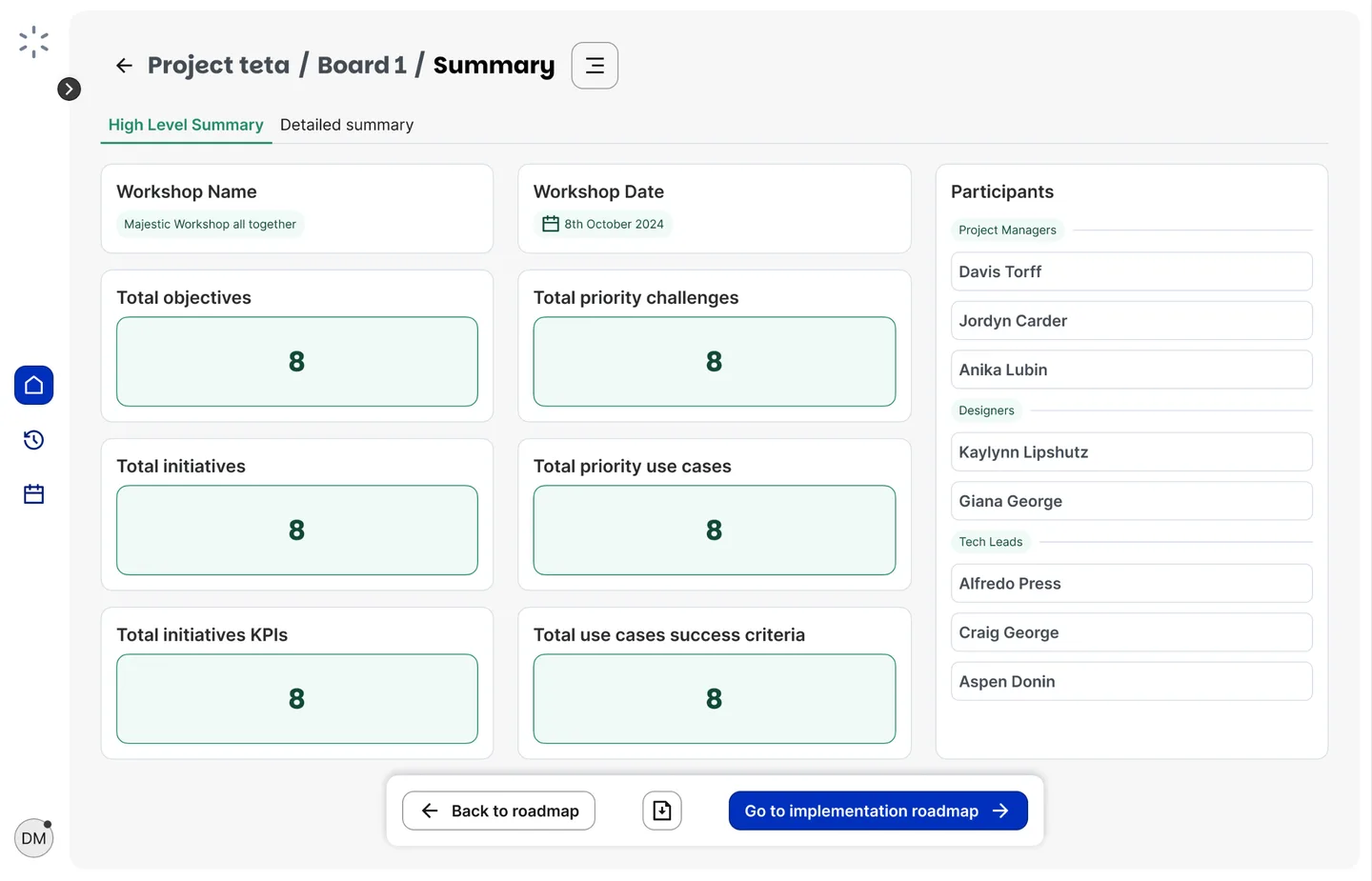
Consolidate the workshop outcomes into a report that can be shared with the customer organization.
The report can be delivered as a Word document, a PowerPoint presentation, or any other format aligned with vendor standards.
Preparing the report is a collaborative effort, involving the vendor participants who contributed during the workshop.
Regardless of format, include in the report the following:
- explanation of the workshop methodology
- timeline covering pre-workshop activities and the workshop session
- participant list including names, titles, contact details, and roles such as business owner or SME (including interviewees who did not attend the workshop)
- summary of the pre-workshop interviews and or questionnaires
- workshop agenda
- summary of workshop discussions, including screenshots of the digital tool as completed during the session
- summary of agreed next steps, including owners and due dates
- relevant comments and observations shared by customer and vendor participants during or after the workshop
This report becomes the shared reference point for decisions made, priorities agreed, and actions required.
Step 4.2 Presentation of Workshop Results and Next Steps
Once the report is ready, schedule a follow-up session with workshop participants and include any additional stakeholders who were not present but influence the decision process.
Use the session to:
- present the report and walk through the key outcomes
- collect feedback and confirm whether updates are required
- formally hand over the final report and confirm how it will be used going forward
The customer organization can then reuse the report to communicate outcomes internally, align additional stakeholders, and advance the engagement with the vendor based on a clear, documented foundation.
Ideally, the digital tool used to facilitate the workshop should allow the vendor to quickly generate the report.
Quality Gates
- Key customer stakeholders confirm in writing that the workshop report accurately reflects the discussion, outcomes, and decisions.
- Key customer stakeholders confirm in writing commitment to execute the agreed next steps, including owners and timelines.
Sales Enablement Artifacts
Register for free on the Value Accelerator website to download templates and tools that support execution of this Milestone.
Important note:
A dedicated digital tool purposely designed by the Value Accelerator team is available to facilitate the Value Design Workshop. Reach out to the Value Accelerator team to learn more.
Sales enablement artifacts. The templates, canvases and calculators for this milestone are free to download.
Get the Value Design Workshop toolkit